


Natures Pantry
Updated: Jun 20
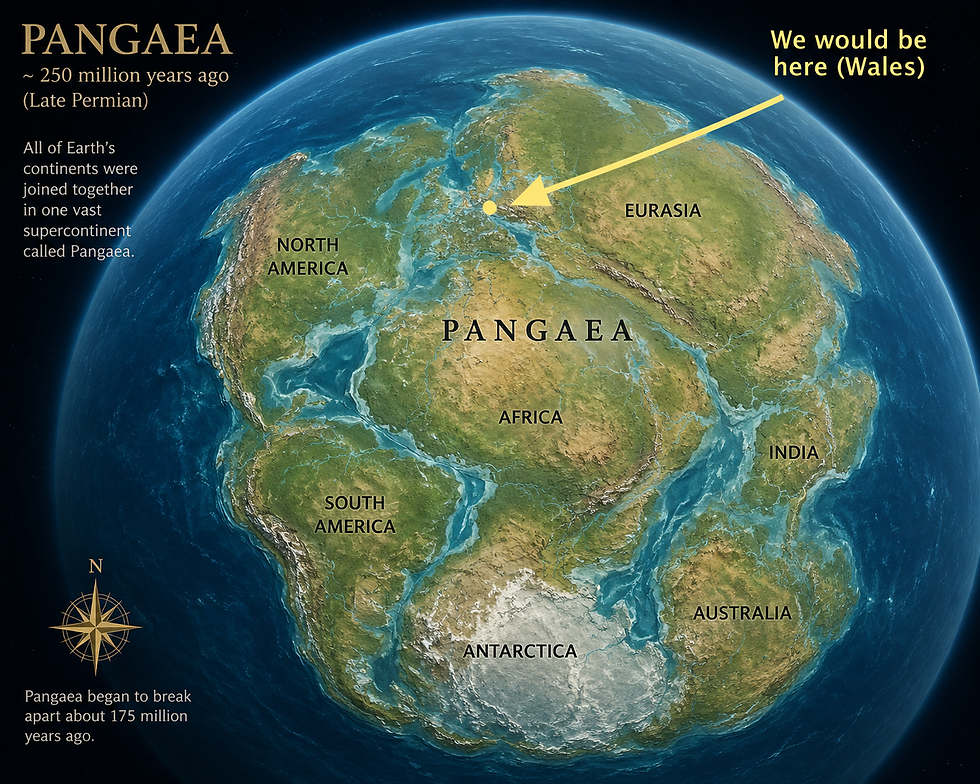
From One World, to Many
When Pangaea began to break apart around 200 million years ago, the continents slowly drifted into the positions we recognise today. Over millions of years, plants and animals adapted to their new environments, creating the incredible diversity of life we see across the globe. Africa became home to some of Earth's most iconic species, many of which now face an uncertain future. Explore Africa's Endangered Species →
Nature's Pantry – Pangaea
One Ancient World
Long before continents had names, the Earth was joined together as a single vast landmass known as Pangaea.
Over millions of years, the land slowly divided, drifting apart to form the continents we know today. As forests became separated by oceans and grasslands stretched across distant lands, the animals that once shared common ancestors began following different paths.
Some adapted to the mountains and woodlands of Europe, while others evolved beneath the African sun. Though separated by time and distance, many still carry traces of their shared heritage.
The Welsh pony and the zebra. The wildcat and the panther. The raven and its African cousins. Each is part of a story far older than human history.
Nature's Pantry is a reminder that all life is connected. The creatures that roam the savannas, forests, mountains and coastlines of our world are not strangers to one another, but distant branches of the same ancient tree.
Though oceans now separate them, their stories began on the same Earth, beneath the same skies, in a world that was once one.
The landscapes of Wales and Africa may seem worlds apart—misty hills and green valleys on one hand, vast savannahs and ancient deserts on the other. Yet both are chapters in the same story. Their wildlife evolved along different paths, but all life shares roots that reach back to a time when the world itself was joined together as one.

The Ravens of Two Continents
🐦⬛ Welsh Raven
Common Raven
The raven found in Wales is the largest member of the crow family in Britain. It has glossy black feathers, a powerful beak, and a deep, distinctive croaking call. Ravens are highly intelligent, capable of problem-solving, and have long been woven into Welsh and Celtic folklore.
Size: Around 54–67 cm (21–26 inches) long Wingspan: Up to 1.5 metres (5 feet)Colour: Entirely black with an iridescent blue-purple sheen
🐦⬛ African White-necked Raven
White-necked Raven
Found in eastern and southern Africa, the White-necked Raven is instantly recognisable by the patch of white feathers around the back of its neck. Like its Welsh cousin, it is highly intelligent and adaptable, often living among rocky hills, mountains, and cliffs.
Size: Around 50–54 cm (20–21 inches) long Wingspan: About 1 metre (3.3 feet) Colour: Black body with a distinctive white collar
A Shared Ancestor
Although separated by thousands of miles, both ravens belong to the same crow family and share many characteristics: intelligence, adaptability, curiosity, and a preference for rugged landscapes. They are distant relatives whose evolutionary story stretches back millions of years. One watches over the misty hills of Wales, the other the sunlit mountains of Africa, yet both remind us of the ancient connections that link life across our planet.

🐎 Welsh Mountain Pony
Built for:
Cold, wet weather
Steep hills and mountains
Living alongside people
Characteristics:
Thick winter coat
Strong hooves for rocky terrain
Generally calm and trainable
Forms close bonds with humans
Many coat colours (bay, chestnut, grey, black)
Strengths:
Sure-footed
Hardy
Intelligent
Can carry riders and pull loads
🦓 Plains Zebra
Built for:
Hot African savannahs
Escaping predators
Life in large herds
Characteristics:
Distinctive black and white stripes
More powerful neck and shoulders
Highly alert and defensive
Difficult to domesticate
Every zebra's stripe pattern is unique
Strengths:
Fast runner (up to about 40 mph / 65 kmh)
Excellent eyesight and hearing
Strong kick that can injure lions
Safety in numbers
Horses
Over thousands of years, humans selectively bred horses that were willing to work with us.
A horse will often:
Look to a human for guidance.
Accept training.
Form strong partnerships.
Zebras
Zebras evolved with constant predator pressure from lions, hyenas, wild dogs, and leopards.
As a result they tend to be:
More suspicious.
More reactive.
Less predictable.
Much harder to train.
A zebra's first instinct is often:
"Run first. Ask questions later."
A horse is more likely to pause and assess the situation.
Shared Ancestry
Both belong to the horse family, the Equidae.
Equidae
They share:
Similar body shape.
Hooves instead of claws.
Grazing diets.
Social herd behaviour.
A common ancestor that lived millions of years ago.
The Welsh mountain pony and the African zebra followed different paths through time.
One became a trusted companion of humankind, carrying riders across hills and valleys.
The other remained truly wild, roaming the vast grasslands of Africa beneath the watchful eyes of predators.
Different lands. Different lives. Yet both are descendants of the same ancient family, whose story began long before the continents took their present shape.

🐱 Welsh Wildcat
European Wildcat
Size
Weight: 3–8 kg
Body length: 45–75 cm
Built for
Dense woodland
Hills and moorland
Cold, wet weather
Characteristics
Thick striped coat
Bushy ringed tail with a blunt black tip
Excellent hearing and night vision
Solitary hunter
Prey
Rabbits
Mice
Voles
Small birds
🐆 African Leopard
Leopard
Size
Weight: 30–90 kg
Body length: 90–190 cm
Built for
Savannah
Woodland
Mountains
Rainforest
Characteristics
Powerful muscular body
Rosette-pattern coat for camouflage
Exceptional climber
Can drag prey heavier than itself into trees
Prey
Antelope
Monkeys
Birds
Warthogs
Small mammals
Similarities
Despite the size difference, they share many traits:
✓ Solitary lifestyle
✓ Mostly active at dawn, dusk, or night
✓ Ambush hunters
✓ Excellent climbers
✓ Keen eyesight and hearing
✓ Highly territorial
Both rely on stealth rather than chasing prey over long distances.
Biggest Difference
The Wildcat
The Welsh wildcat survives by remaining hidden.
Its strategy is:
"Don't be seen."
It hunts small prey and avoids confrontation wherever possible.
The Leopard
The leopard survives through power as well as stealth.
Its strategy is:
"Strike once and strike hard."
A leopard can kill prey several times its own weight and carry it into a tree to keep it away from lions and hyenas.
A Tale of Two Hunters
The wildcat slips silently through the misty woodlands of Britain, while the leopard stalks beneath African acacias. One weighs little more than a domestic cat. The other is among Africa's most feared predators. Yet both are masters of patience, stealth, and survival. Though separated by continents and millions of years of evolution, they remain branches of the same ancient feline family tree.

Pangaea may have broken apart millions of years ago, but its story lives on in every continent, every species, and every one of us.
The world may be divided by oceans, yet we all share the same ancient beginning.
Long before borders, nations, or even continents as we know them today, life shared a common home.
When Pangaea slowly divided, plants, animals, and eventually human populations became separated by vast oceans and changing landscapes. Over millions of years, each adapted to its new surroundings, shaped by climate, terrain, and the challenges of survival.
Yet despite these differences, the connection remains.
Whether in the forests of Wales, the savannahs of Africa, the mountains of Asia, or the plains of the Americas, all life shares the same ancient roots.
Pangaea reminds us that diversity did not begin in separation—it grew from a common beginning. We may have adapted to different corners of the Earth, but we remain part of the same story, written across a planet that was once one.
What I find most remarkable about Pangaea is not that the world divided, but that life adapted.
Separated by oceans and shaped by different climates, species evolved in unique ways to survive in their new homes. Humans, animals, and plants all changed with their surroundings, developing characteristics suited to the environments in which they lived.
Yet beneath those differences, the connection remains.
From the misty hills of Wales to the African savannah, life tells the same story: one beginning, many paths.
We may look different, live differently, and inhabit different corners of the world, but we all share the same ancient roots.

Comments