


Music is Therapy.
Updated: May 25

Music has a way of reaching places words can-not. In its quiet rhythm and gentle flow, it can calm the mind, ease the heart, and carry us somewhere softer… somewhere safer.
From ancient Celtic melodies to modern echoes of sound, music has always been a form of healing — a bridge between emotion and peace.
Take a moment… breathe… and simply listen.
🌿 What is Music Therapy?
Music therapy is the use of music to support mental, emotional, and even physical wellbeing.
It’s not just “listening to nice songs” — it can include:
Listening to music intentionally
Singing or humming
Playing instruments (even simple ones)
Using rhythm (like drumming or tapping)
It’s even used in hospitals, care homes, and mental health settings.
🌙 Why Music Affects Us So Deeply
Music taps into the brain in a powerful way:
It can change mood almost instantly
It can trigger memories (good or bad)
It can calm the nervous system
It can even reduce pain and anxiety
That feeling you get when a song gives you goosebumps? That’s your brain releasing dopamine (a “feel good” chemical).
🍃 Benefits of Music Therapy
People use music to:
Ease anxiety and stress
Help with sleep
Support depression
Improve focus and clarity
Process grief or emotions
It’s especially powerful because you don’t need words —music speaks where words fail.
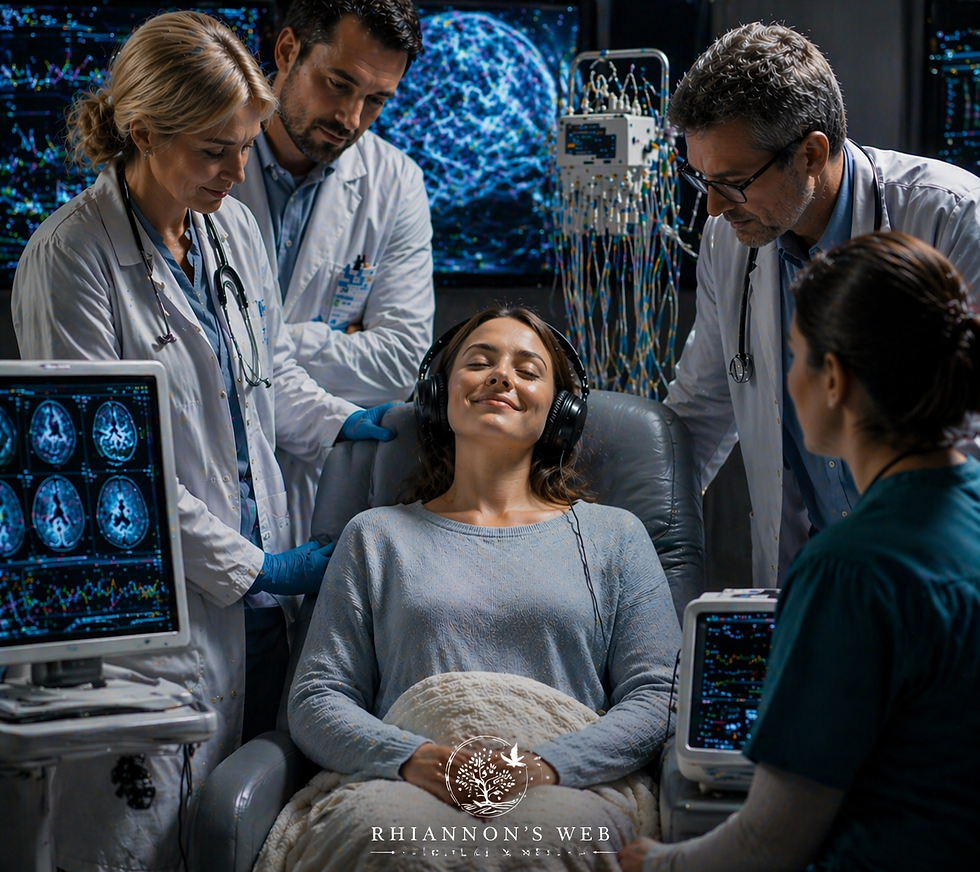
The "magic" of music therapy is actually grounded in sophisticated neuroscience and biochemistry. As of 2026, researchers have pinpointed three major scientific pillars that explain why music can heal the brain.
1. The "Big Three" Biological Responses
When you engage with music, your body undergoes measurable chemical changes:
The Dopamine Loop: Functional MRI (fMRI) scans show that music triggers the nucleus accumbens, the same "reward centre" activated by food or exercise. Research from late 2025 suggests that music you choose yourself releases significantly more dopamine than music selected by others, explaining why personal preference is central to therapy.
Cortisol Regulation: Recent meta-analyses have quantified music’s "anti-stress" effect, showing it consistently lowers cortisol levels and heart rate. In some clinical trials, music listening was found to be as effective as benzodiazepines (anti-anxiety meds) for preoperative nerves.
Oxytocin & Social Bonding: Singing or playing in a group releases oxytocin, the "bonding hormone." This is why music therapy is a powerhouse for treating social isolation and building rapport in patients with autism or PTSD.
2. Advanced Neuroplasticity
Music is a "whole-brain" stimulus. Because it involves timing (motor), pitch (auditory), and lyrics (language), it forces different brain regions to talk to each other.
Compensatory Networks: In 2026, studies using Magnetoencephalography (MEG) revealed that music therapy helps dementia patients by activating compensatory neural networks. When one "road" in the brain is blocked by disease, music helps the brain build a "detour" through healthier tissue to maintain memory and speech.
The 200ms "Dip": A breakthrough study from Stanford (2025/2026) discovered that brain waves in the motor cortex consistently "dip" or prime themselves exactly 200 milliseconds before a dominant beat. By timing medical brain stimulation (TMS) to this specific musical rhythm, doctors can increase the effectiveness of treatments for depression and stroke by up to 77%.
3. The Science of the "Groove" (Entrainment)
There is a biological phenomenon called Neural Entrainment, where your brain waves literally synchronize to the external rhythm.
Motor Recovery: For patients with Parkinson’s, a steady beat acts as an external "pacemaker." The brain's motor neurons fire in sync with the rhythm, bypassing damaged internal timing mechanisms and allowing the patient to walk more fluidly.
Interhemispheric Connectivity: New real-time fMRI neurofeedback shows that music can help balance the communication between the left and right hemispheres, which is often "lopsided" in individuals with severe mood disorders.
Comments