


North America

North America – Land of Wilderness
North America is a continent of remarkable contrasts, stretching from the frozen Arctic tundra of the far north to the warm deserts of the south. Its landscapes include towering mountain ranges, ancient forests, sweeping grasslands, crystal lakes, and rugged coastlines.
Home to some of the world's most iconic wildlife, North America provides sanctuary for powerful predators, majestic birds, and great herds of grazing animals. From the soaring Bald Eagle and the mighty Grizzly Bear to the free-roaming Mustang and the resilient American Bison, the continent remains a symbol of wilderness and freedom.
For thousands of years, these lands have been shaped by nature, climate, and the deep connection between wildlife and the people who have lived alongside it. Today, many species face challenges from habitat loss, climate change, and human expansion, making conservation more important than ever.
Join us as we explore the landscapes, animals, and natural wonders of North America — a continent where the spirit of the wild still runs free.

Mustang – Spirit of the American West
The Mustang is one of North America's most iconic animals and a symbol of freedom, endurance, and the untamed spirit of the wild. Descended from horses brought to the Americas by Spanish explorers in the 16th century, some escaped or were released, forming wild herds that spread across the open plains and deserts of the American West.
Over generations, Mustangs adapted to life in harsh environments, developing strength, intelligence, and remarkable resilience. Living in family groups led by experienced mares and stallions, they travel great distances in search of food and water, surviving in conditions that many domestic horses would find challenging.
Mustangs come in a variety of colours and sizes, reflecting their mixed ancestry. Despite their wild nature, they remain social animals with strong bonds within their herds. Their ability to thrive in remote landscapes has made them a lasting symbol of independence and adventure.
Today, wild Mustang populations are carefully managed to help maintain a balance between conservation, available habitat, and other land uses. Although their numbers are far lower than in the past, these magnificent horses continue to roam parts of the American West, inspiring people around the world with their beauty and free spirit.
Quick Facts
• Scientific Name: Equus ferus caballus
• Type: Mammal
• Diet: Herbivore
• Habitat: Grasslands, deserts, mountains and open plains
• Lifespan: 20–30 years
• Status: Managed wild populations
"The Mustang is more than a horse; it is a living symbol of freedom, resilience, and the spirit of the open land."

🐺 The Gray Wolf – Guardian of the Wilderness
The Gray Wolf (Canis lupus) is one of North America's most famous wild animals. Once found across much of the continent, wolves help keep nature in balance by controlling prey populations and maintaining healthy ecosystems.
Wolves are intelligent and highly social animals that live in family groups called packs. They work together to hunt, protect their territory, and raise their young.
Quick Facts
• Scientific Name: Canis lupus
• Habitat: Forests, mountains, tundra and grasslands
• Diet: Deer, elk, moose and smaller animals
• Weight: 27–54 kg (60–120 lbs)
• Lifespan: 6–8 years in the wild
• Top Speed: Up to 60 km/h (37 mph)
Why Wolves Matter
Wolves play an important role in keeping ecosystems healthy. By controlling deer and other prey populations, they help forests, rivers and other wildlife thrive.
Conservation
By the early 1900s, wolves had disappeared from many parts of North America due to hunting and habitat loss. Conservation efforts have helped some populations recover, but they still face challenges today.
"The howl of the wolf remains one of the most powerful sounds of the North American wilderness."

🦅 Bald Eagle – King of the Skies
The Bald Eagle (Haliaeetus leucocephalus) is one of North America's most iconic birds. Known for its striking white head, powerful beak and impressive wingspan, it can often be seen soaring above rivers, lakes and forests in search of prey.
A symbol of strength, freedom and resilience, the Bald Eagle is also one of the world's greatest conservation success stories. Once close to extinction in many parts of North America, careful protection and conservation efforts have helped its numbers recover.
Quick Facts
• Scientific Name: Haliaeetus leucocephalus
• Habitat: Lakes, rivers, coastlines and forests
• Diet: Mainly fish, but also waterfowl and small mammals
• Wingspan: Up to 2.3 metres (7.5 feet)
• Weight: 3–6.3 kg (6.6–14 lbs)
• Lifespan: 20–30 years in the wild
Masters of the Air
Bald Eagles have exceptional eyesight, allowing them to spot fish from great distances. Their broad wings enable them to soar effortlessly on air currents while searching for food.
A Conservation Success Story
By the 1960s, Bald Eagle populations had declined dramatically due to habitat loss, hunting and the effects of pesticides such as DDT. Following legal protection and conservation efforts, their numbers recovered, making them a powerful symbol of hope for wildlife conservation.
Why Eagles Matter
As top predators, Bald Eagles help maintain healthy ecosystems. Their presence is often a sign of clean waterways and thriving wildlife populations.
"Soaring above mountains, forests and rivers, the Bald Eagle remains one of the greatest symbols of the North American wilderness." 🦅🍁🌲
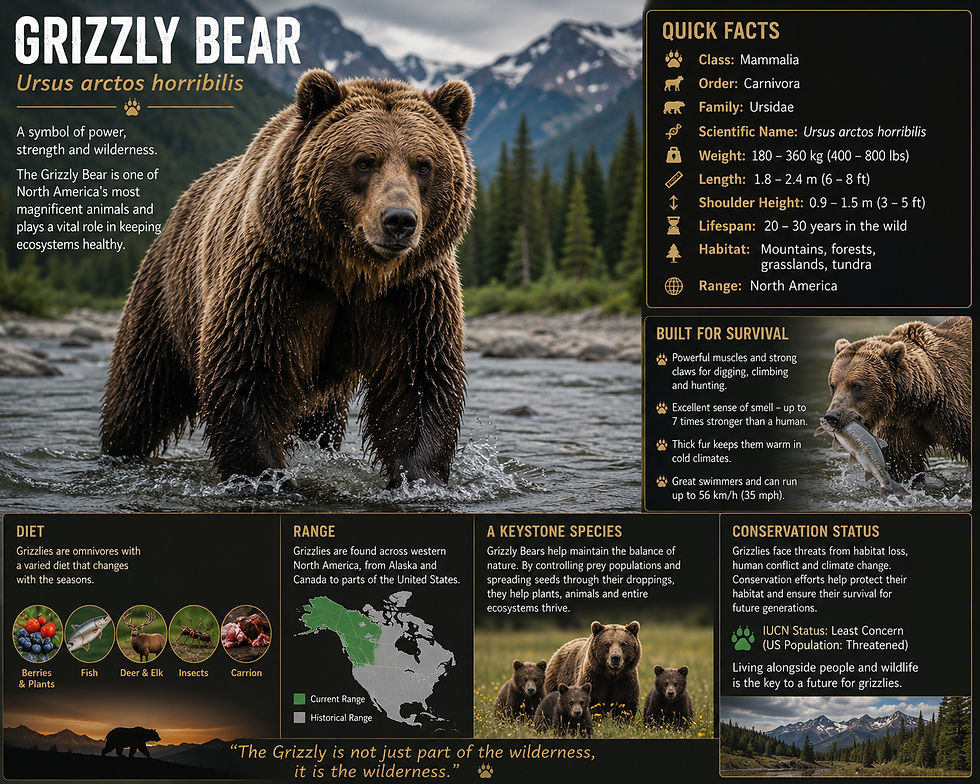
🐻 Grizzly Bear – Giant of the Wilderness
The Grizzly Bear (Ursus arctos horribilis) is one of North America's largest and most powerful land mammals. Found in forests, mountains and river valleys, grizzlies are a symbol of the continent's wild and untamed landscapes.
Despite their fearsome reputation, grizzly bears spend much of their time foraging for food, raising their young and preparing for winter hibernation.
Quick Facts
• Scientific Name: Ursus arctos horribilis
• Habitat: Forests, mountains, tundra and grasslands
• Diet: Omnivore – berries, roots, fish, insects and mammals
• Weight: 180–360 kg (400–800 lbs)
• Height: Up to 2.5 metres (8 feet) when standing
• Lifespan: 20–30 years in the wild
Built for Survival
Grizzly bears have powerful muscles, long claws and an excellent sense of smell. They can detect food from miles away and are strong swimmers capable of crossing rivers and lakes with ease.
A Keystone Species
Grizzlies play an important role in maintaining healthy ecosystems. By spreading seeds through their droppings and helping control prey populations, they contribute to the balance of nature.
Conservation
Although grizzly populations remain healthy in parts of Alaska and Canada, they face challenges from habitat loss and increasing contact with humans. Conservation efforts help protect both bears and the wilderness they depend upon.
Why Grizzlies Matter
The grizzly bear represents the strength and resilience of North America's wilderness. Its presence is a sign of healthy forests, rivers and mountain ecosystems.
"The grizzly is not just part of the wilderness – it is the wilderness."
🐻🏔️🌲

🦬 American Bison – Giant of the Great Plains
The American Bison (Bison bison) is the largest land mammal in North America and one of the continent's most iconic animals. Once roaming the Great Plains in vast herds numbering millions, the bison became a powerful symbol of strength, resilience and survival.
These magnificent animals are perfectly adapted to life on the open grasslands, where they have lived for thousands of years.
Quick Facts
• Scientific Name: Bison bison
• Habitat: Grasslands, prairies and open plains
• Diet: Grasses, sedges and other plants
• Weight: 450–1,000 kg (1,000–2,200 lbs)
• Height: Up to 2 metres (6.5 feet) at the shoulder
• Lifespan: 15–25 years in the wild
Built for the Plains
Bison have powerful shoulders, thick fur and strong legs that allow them to survive harsh winters and travel long distances in search of food. Despite their size, they can run at speeds of up to 56 km/h (35 mph).
A Remarkable Comeback
During the late 1800s, uncontrolled hunting reduced bison numbers from tens of millions to fewer than 1,000 animals. Thanks to conservation efforts, protected herds now exist across North America, helping to secure the future of this remarkable species.
Why Bison Matter
Bison play an important role in maintaining healthy grassland ecosystems. Their grazing encourages plant diversity and creates habitats for many other species.
A Living Symbol
For thousands of years, Indigenous peoples lived alongside bison and depended upon them for food, clothing and shelter. Today, the bison remains a powerful symbol of North America's natural and cultural heritage.
"The American Bison is more than an animal – it is a symbol of the land, the people and the enduring spirit of North America."
🦬🌾🍁

🍁 Reflection – The Spirit of North America
From the windswept prairies where bison once thundered in their millions, to the towering mountains watched over by eagles soaring on the thermals, North America remains a land of vast wilderness and remarkable wildlife.
Here, wolves still howl beneath the moon, grizzly bears roam ancient forests, and wild mustangs run across open landscapes much as they have for generations. These animals remind us of a time when nature ruled the horizon and the land stretched beyond imagination.
Although many species have faced challenges from hunting, habitat loss and human expansion, their survival is a testament to nature's resilience and the growing efforts to protect what remains.
North America teaches us that wilderness is more than scenery. It is a living connection to the past, a refuge for countless species, and a reminder that even in a modern world, there are still places where nature's spirit runs free.
"To hear the wolf howl, watch an eagle soar, or witness a bison crossing the plains is to glimpse the untamed heart of North America."
Comments