


Africa's Endangered Species
Africa's Endangered

The Elephant
Few creatures embody the spirit of Africa more than the elephant. For millions of years, these gentle giants have roamed the continent's grasslands, forests, and river valleys, shaping the very landscapes around them. Elephants are more than just the largest land animals on Earth. They are intelligent, emotional, and highly social creatures that live in close family groups led by experienced matriarchs. They mourn their dead, care for their young, and possess remarkable memories that help guide their herds through times of drought and hardship. Yet despite their strength and size, elephants face threats unlike any they have encountered throughout their long history.
Why Elephants Matter
Elephants are often called "ecosystem engineers." As they travel, they create paths through dense vegetation, dig for water that other animals can use, and disperse seeds across vast distances. Many African species benefit from the work elephants do simply by living their lives.
The Threats They Face
Today, African elephants face increasing pressure from poaching, habitat loss, and conflict with humans. Expanding settlements and agriculture reduce the space available for migration, while illegal ivory hunting continues to threaten populations in some regions. Although conservation efforts have helped protect many herds, the future of Africa's elephants remains uncertain.
A Reflection
The elephant's story is not one of weakness. It is a story of survival. A creature that has endured ice ages, droughts, predators, and countless changes to the Earth itself. Yet its greatest challenge has come in the brief moment humans have shared the planet with it. Whether future generations will know elephants as living giants or only as photographs and memories depends on the choices we make today.
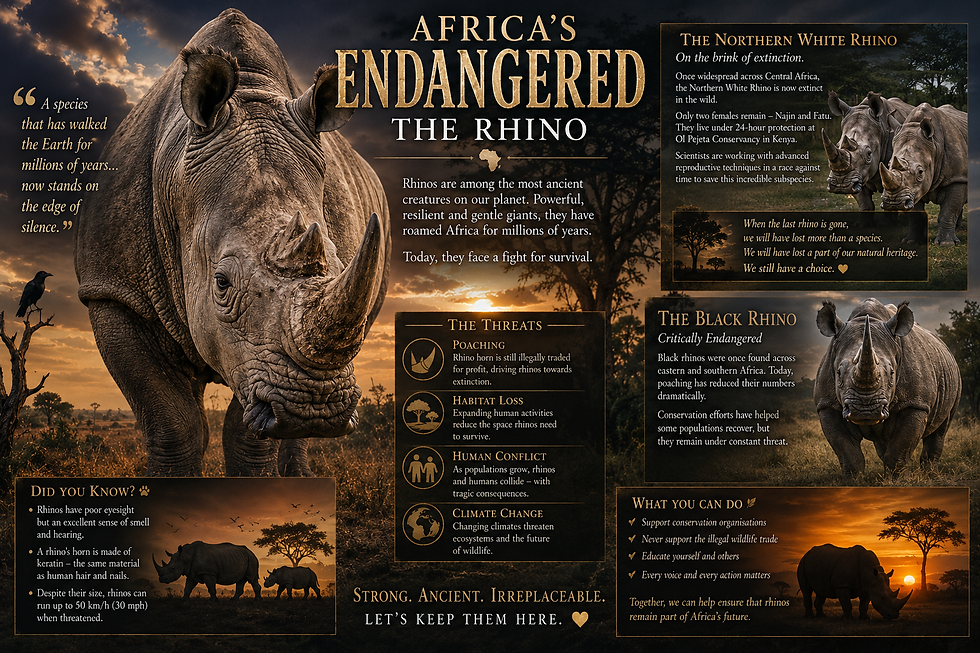
The Rhino
For millions of years, rhinos have walked the African landscape, surviving ice ages, droughts, and countless changes to the natural world.
Yet today, one of nature's most resilient creatures faces its greatest challenge.
Driven towards extinction by poaching and habitat loss, the rhino has become a symbol of both humanity's capacity for destruction and its determination to protect what remains.
When we look into the eyes of a rhino, we are looking at a survivor from another age—one whose future now rests in our hands.
A Reflection
There is something humbling about the rhino.
Long before our towns, roads, and cities existed, rhinos walked these lands. They drank from ancient rivers, crossed vast grasslands, and witnessed countless generations come and go.
They ask nothing of us.
They do not seek our approval, our admiration, or our possessions. They simply exist, as nature intended.
Yet in the brief moment humanity has shared the Earth with them, their future has become uncertain.
It is difficult to comprehend that a creature shaped by millions of years of evolution could disappear within a single human lifetime.
When a species is lost, we lose more than an animal. We lose a story. A unique thread in the tapestry of life that can never be replaced.
The rhino reminds us that strength alone is not enough to ensure survival. Even the mightiest creatures can fall when wisdom and compassion are absent.
Perhaps the true measure of humanity is not how much we take from the natural world, but how much we are willing to protect.
The rhino's future is still being written.
Let us hope that future includes the sound of heavy footsteps across the African plains for generations yet to come.

African Wild Dog
Once widespread across Africa, the African wild dog is now one of the continent's most endangered predators. Fewer than 7,000 remain in the wild, scattered across isolated populations. Their greatest threats are habitat loss, conflict with humans, and diseases caught from domestic dogs.
Known for their striking patchwork coats, wild dogs are highly social animals that live and hunt in packs. They are among Africa's most successful hunters, often working together with remarkable teamwork and communication.
Reflection
The African wild dog reminds us that survival is not always about strength alone. Their success comes from cooperation, loyalty, and family bonds. In a world where wild spaces are shrinking, these remarkable animals show us how much can be achieved when individuals work together for the good of the pack.
Their future now depends on whether humanity can do the same.

Cheetah
(Acinonyx jubatus)
The cheetah is the fastest land animal on Earth, capable of reaching speeds of up to 70 mph (113 km/h). Built for speed rather than strength, its lightweight body, long legs, flexible spine and powerful tail allow it to accelerate faster than almost any other creature.
Unlike lions and leopards, cheetahs rely on speed and agility to catch their prey. They use their exceptional eyesight to spot animals from great distances before launching a short, explosive chase across the African savanna.
Despite their incredible abilities, cheetah numbers have declined dramatically. Habitat loss, conflict with humans, and the loss of natural prey have left many populations isolated and vulnerable.
Reflection
The cheetah teaches us that every creature has its own gifts. It does not possess the strength of a lion or the power of an elephant, yet it survives through speed, focus and precision.
In a world that often values power above all else, the cheetah reminds us that success can come from using our unique strengths rather than trying to be something we are not.
Conservation Status: Vulnerable Estimated Population: Around 6,500–7,000 adults remaining in the wild Habitat: Grasslands, savannas and open woodlands across Africa Main Threats: Habitat loss, human conflict, poaching and declining prey numbers
Interesting Facts
Fastest land animal on Earth.
Can accelerate from 0–60 mph in around 3 seconds.
Uses its tail like a rudder when turning at high speed.
Black "tear marks" beneath the eyes help reduce glare from the sun.
Most hunts take place during daylight hours.

Mountain Gorilla
(Gorilla beringei beringei)
Mountain gorillas are among our closest living relatives, sharing around 98% of our DNA. They live in the mist-covered mountain forests of Central Africa, where family groups roam through dense vegetation in search of leaves, shoots, roots and fruit.
Despite their immense strength, mountain gorillas are generally gentle and peaceful animals. Family groups are led by a dominant silverback male whose role is to protect and guide the group rather than rule through aggression. Young gorillas spend much of their time playing, learning important social skills that help them thrive within the family.
Once pushed to the brink of extinction, mountain gorillas remain one of the world's rarest great apes. Conservation efforts have helped their numbers slowly recover, but they still face threats from habitat loss, disease and human activity.
Reflection
When we look into the eyes of a gorilla, we see something familiar. Their expressions reveal curiosity, affection, sadness and joy—emotions that remind us how closely connected all life truly is.
The mountain gorilla teaches us that strength and gentleness can exist together. Their survival is a symbol of hope, showing that when people choose to protect nature, recovery is possible.
Conservation Status: EndangeredEstimated Population: Around 1,000 individualsHabitat: Mountain forests of Rwanda, Uganda and the Democratic Republic of the CongoDiet: Leaves, stems, shoots, roots and fruitMain Threats: Habitat loss, disease, poaching and human encroachment
Interesting Facts
Mountain gorillas live in family groups called troops.
A fully grown silverback can weigh over 180 kg (400 lbs).
Each gorilla has a unique nose print, much like a human fingerprint.
They build fresh nests from vegetation every evening.
Gorillas rarely need to drink water because they obtain most of their moisture from the plants they eat.

African Penguin
(Spheniscus demersus)
The African penguin is the only penguin species found on the African continent. Living along the coastlines of South Africa and Namibia, these remarkable birds are perfectly adapted to life in warmer waters, where they hunt fish such as sardines and anchovies.
Often called the "jackass penguin" because of its donkey-like braying call, the African penguin is a highly social bird that nests in colonies on rocky islands and coastal shores. Both parents share the responsibility of incubating eggs and caring for their chicks.
Sadly, African penguin numbers have declined dramatically over the last century. Overfishing, habitat loss, pollution and climate change have all contributed to their decline, making them one of Africa's most endangered seabirds.
Reflection
The African penguin reminds us that even the smallest creatures can face enormous challenges. Though they cannot roar like lions or charge like rhinos, their struggle for survival is no less important.
Their future depends on the health of the oceans they call home, reminding us that every choice we make today can ripple across the natural world tomorrow.
Conservation Status: Endangered Estimated Population: Approximately 10,000–20,000 breeding pairs Habitat: Coastal islands and rocky shorelines of South Africa and Namibia Diet: Sardines, anchovies, squid and small fish Main Threats: Overfishing, habitat loss, oil pollution, climate change and disease
Interesting Facts
The only penguin species that breeds in Africa.
Can swim at speeds of up to 20 km/h (12 mph).
Uses its wings like flippers to "fly" through water.
Recognisable by the black horseshoe-shaped band across its chest.
Each penguin's pattern of black spots is unique, much like a fingerprint.

Grevy's Zebra
(Equus grevyi)
The Grevy's zebra is the largest and rarest of the world's three zebra species. Native to the dry grasslands and scrublands of Kenya and Ethiopia, it is easily recognised by its narrow black-and-white stripes, large rounded ears and elegant appearance.
Unlike other zebras, Grevy's zebras live in smaller, less structured groups and often roam vast distances in search of food and water. Their large ears help them regulate body temperature and detect danger across the open plains.
Once widespread across East Africa, Grevy's zebra populations have declined significantly due to habitat loss, competition with livestock, drought and human activity. Today, fewer than 2,500 remain in the wild.
Reflection
Every Grevy's zebra carries a unique pattern of stripes, a reminder that no two lives are exactly the same. In nature, individuality is not a weakness—it is part of the beauty and diversity that helps species survive.
Their struggle reminds us that preserving wildlife is not only about saving animals, but also about protecting the unique stories written across the natural world.
Conservation Status: Endangered Estimated Population: Fewer than 2,500 individuals Habitat: Arid and semi-arid grasslands of Kenya and Ethiopia Diet: Grasses, leaves, bark, shrubs and fruit Main Threats: Habitat loss, drought, competition with livestock and human encroachment
Interesting Facts
The largest of all zebra species.
Each zebra's stripe pattern is completely unique.
Can survive longer without water than many other zebra species.
Their large ears help cool the body in hot climates.
Foals can recognise their mother's stripe pattern shortly after birth.

Pangolin
(Order: Pholidota)
The pangolin is one of the most unusual mammals on Earth and the only mammal covered in protective scales. These scales are made from keratin—the same material that forms human fingernails and hair.
Found across Africa and Asia, pangolins are shy, nocturnal animals that spend much of their time searching for ants and termites. Using their powerful claws, they tear open insect nests and feed with a remarkably long, sticky tongue that can be longer than their body.
When threatened, a pangolin curls into a tight ball, using its tough scales as armour against predators. This unique defence has helped the species survive for millions of years.
Sadly, pangolins are now among the most heavily trafficked mammals in the world. They are hunted illegally for their scales and meat, making them one of the planet's most endangered animals.
Reflection
The pangolin reminds us that nature's greatest treasures are not always the largest or the loudest. Quiet, gentle and rarely seen, it survives through patience and adaptation rather than strength.
Its struggle teaches us that even the most hidden creatures deserve protection, for once a species disappears, the world loses something truly irreplaceable.
Conservation Status: All African pangolin species are threatened, with some listed as Endangered or Critically Endangered .Habitat: Forests, savannas, grasslands and woodlands across Africa. Diet: Ants and termites. Main Threats: Illegal wildlife trafficking, habitat loss and human disturbance.
Interesting Facts
The world's only scaly mammal.
Can consume millions of ants and termites each year.
Has no teeth and swallows small stones to help grind food.
Its tongue can be longer than its head and body combined.
When frightened, it rolls into a near-perfect armoured ball.
There are four species of pangolin found in Africa.
Africa's Endangered Species

A Summary
Africa is home to some of the most extraordinary wildlife on Earth, yet many of its iconic species now face an uncertain future. Habitat loss, climate change, poaching, pollution and human expansion continue to place immense pressure on animals that have roamed the continent for thousands, and in some cases millions, of years.
The mighty African Elephant faces threats from habitat loss and conflict with humans. The powerful Black Rhinoceros continues to battle against poaching driven by the illegal wildlife trade.
The highly social African Wild Dog struggles as its natural range becomes increasingly fragmented, while the graceful Cheetah fights for survival in shrinking grasslands.
Deep within Africa's mountain forests, the gentle Mountain Gorilla remains vulnerable despite successful conservation efforts. Along the coastlines, the charming African Penguin faces declining fish stocks, pollution and changing oceans.
Across the dry plains of East Africa, the elegant Grevy's Zebra continues to decline, while the secretive Pangolin has become one of the most trafficked mammals on Earth.
Together, these animals tell a story that is both inspiring and heartbreaking. They remind us of nature's beauty, resilience and diversity, but also of our responsibility to protect the world we share.
Reflection
Every species featured on this page represents millions of years of evolution, adaptation and survival. Their future now depends not on their ability to adapt, but on our willingness to coexist.
If we allow them to disappear, we lose more than animals—we lose irreplaceable chapters of Earth's story. By protecting wildlife today, we help ensure that future generations inherit a world still filled with wonder, mystery and life.
The fate of these species is not yet written. Their story, and ours, continues. 🌍
Comments