


Asia
Updated: Jun 15

Asia is the largest and most diverse continent on Earth, stretching from the frozen peaks of the Himalayas to the tropical rainforests of Southeast Asia. Home to some of the world's most remarkable wildlife, its forests, mountains, rivers and grasslands provide sanctuary for countless species found nowhere else on the planet.
Among these are the giant panda, snow leopard, Bengal tiger, Asian elephant and orangutan, each uniquely adapted to their environment through millions of years of evolution. Yet many of these magnificent creatures now face an uncertain future as habitat loss, poaching, pollution and climate change continue to threaten their survival.
Asia's wildlife is more than a collection of animals; it is part of a delicate natural balance that has shaped the continent for thousands of years. By learning about these species and the challenges they face, we can better understand the importance of protecting the rich natural heritage of Asia for future generations.
The story of Asia is one of beauty, resilience and survival. It is a reminder that the future of many extraordinary creatures now rests in our hands.

Giant Panda
The giant panda is one of the world's most recognisable animals and a symbol of wildlife conservation. Native to the misty bamboo forests of central China, pandas spend most of their lives feeding, resting and caring for their young in the mountainous regions they call home.
Although classified as bears, giant pandas have a diet that consists almost entirely of bamboo, consuming up to 12 hours a day feeding to obtain enough nutrients. Their distinctive black and white markings make them instantly recognisable, while their gentle nature has made them beloved around the world.
For many years, habitat loss and low breeding rates placed giant pandas at risk of extinction. Thanks to dedicated conservation efforts, including protected reserves and habitat restoration, panda numbers have slowly increased. However, they still face challenges from habitat fragmentation and climate change, which threaten the bamboo forests upon which they depend.
The giant panda reminds us that conservation can succeed when people work together to protect the natural world. Its survival offers hope that other endangered species may also have a future if action is taken before it is too late.
The giant panda has survived for millions of years, quietly inhabiting the forests of China while civilizations rose and fell around it. Yet despite its strength and resilience, its future now depends largely upon human choices. The panda serves as a gentle reminder that the greatest threats to wildlife are often not found in nature, but in ourselves. By protecting the forests that sustain these remarkable animals, we help preserve a small piece of the world's natural wonder for generations yet to come.
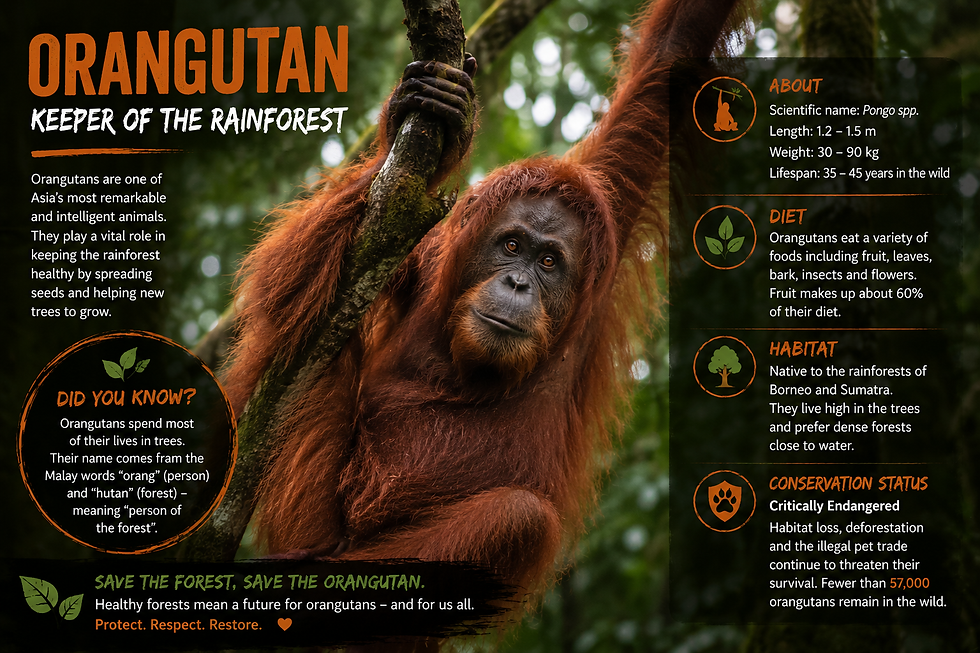
Orangutan
The orangutan is one of humanity's closest living relatives, sharing almost 97% of our DNA. Found only in the rainforests of Borneo and Sumatra, these intelligent great apes spend most of their lives in the trees, where they build nests from branches and leaves to sleep each night.
The name "orangutan" comes from the Malay words orang hutan, meaning "person of the forest." Known for their distinctive reddish-brown hair and remarkable problem-solving abilities, orangutans use tools, learn from experience and display complex social behaviours.
Sadly, orangutans are among the most endangered primates in the world. Large areas of rainforest have been cleared for agriculture, logging and palm oil plantations, leaving many populations isolated and vulnerable. Illegal hunting and the capture of young orangutans for the pet trade have also contributed to their decline.
Conservation groups continue to work tirelessly to protect remaining forests and rehabilitate rescued orangutans. Their survival depends upon preserving the ancient rainforests they have called home for millions of years.
As we watch an orangutan move thoughtfully through the forest canopy, it is impossible not to recognise something of ourselves. Their curiosity, intelligence and capacity for learning remind us that humanity is not separate from nature, but a part of it. The fate of the orangutan is closely linked to the fate of the rainforest, and ultimately to our own future. To protect the forests is to protect one of our closest relatives and a living connection to the natural world from which we all emerged.

Bengal Tiger
The Bengal tiger is one of the most powerful and iconic predators on Earth. Found across parts of India, Nepal, Bhutan and Bangladesh, these magnificent big cats inhabit forests, grasslands and mangrove swamps, where they play a vital role in maintaining the balance of their ecosystems.
Recognisable by their striking orange coats and dark black stripes, no two tigers share the same pattern. Solitary by nature, they are skilled hunters capable of taking down prey much larger than themselves. Their strength, agility and keen senses have earned them a place in the myths, cultures and traditions of Asia for centuries.
Despite their reputation as formidable predators, Bengal tigers face numerous threats. Habitat destruction, human encroachment and illegal poaching have dramatically reduced their numbers over the last century. As forests shrink and prey becomes scarce, conflicts between humans and tigers become increasingly common.
Conservation efforts have helped stabilise some tiger populations through protected reserves, anti-poaching measures and habitat restoration. However, continued protection is essential if future generations are to witness these magnificent animals roaming free in the wild.
The tiger has long been a symbol of strength, courage and wild beauty. Yet even one of nature's most powerful predators cannot survive without the forests and grasslands that sustain it. The decline of the tiger serves as a reminder that no creature, no matter how strong, is immune to the consequences of human activity. By protecting the tiger's habitat, we preserve not only a species, but an entire ecosystem upon which countless forms of life depend.

Asian Elephant (Elephas maximus)
The Asian elephant is the largest land mammal in Asia and has lived across the continent's forests and grasslands for millions of years. Although similar to its African cousin, the Asian elephant is generally smaller, with smaller ears and a more rounded back. Both species are highly intelligent, social animals with strong family bonds.
Asian elephants play a vital role in maintaining healthy ecosystems. As they travel through forests, they disperse seeds, create pathways for other wildlife, and help shape the landscape around them.
Today, Asian elephant populations face increasing pressure from habitat loss, human-wildlife conflict, and poaching. As forests are cleared and human settlements expand, elephant migration routes become fragmented, making survival more difficult.
Asian Elephant vs African Elephant
Asian elephants have smaller, rounded ears, while African elephants have much larger ears shaped like the African continent.
Female Asian elephants usually do not have large visible tusks, unlike many African elephants.
Asian elephants have a more rounded back, while African elephants tend to have a slightly dipped back.
Both species are highly intelligent, emotional animals that live in close family groups led by experienced females.
Reflection
Though separated by continents, Asian and African elephants share much in common. Both are ancient survivors from a world long before humans built cities and borders. Their continued survival reminds us that nature's greatest giants still need our protection in an increasingly crowded world.

Asia is a continent of contrasts. From the frozen mountains of the Himalayas to the dense rainforests of Borneo, it is home to some of the world's most remarkable wildlife. Yet many of these species now face an uncertain future as forests disappear, habitats become fragmented, and the pressures of a growing human population continue to increase.
The panda, orangutan, tiger and elephant each tell a different story, but they share a common challenge: survival in a rapidly changing world. Their future depends not only on conservation efforts, but on our willingness to recognise that we share this planet with them.
Perhaps the greatest lesson nature teaches us is that everything is connected. The loss of a single species affects far more than the animal itself. It alters ecosystems, cultures, and the natural heritage we leave to future generations.
By learning about these animals and the challenges they face, we take the first step towards understanding why they matter. Their story is part of our story too.
Comments