


Climate Change - The World in Black and White.
Updated: Jun 30
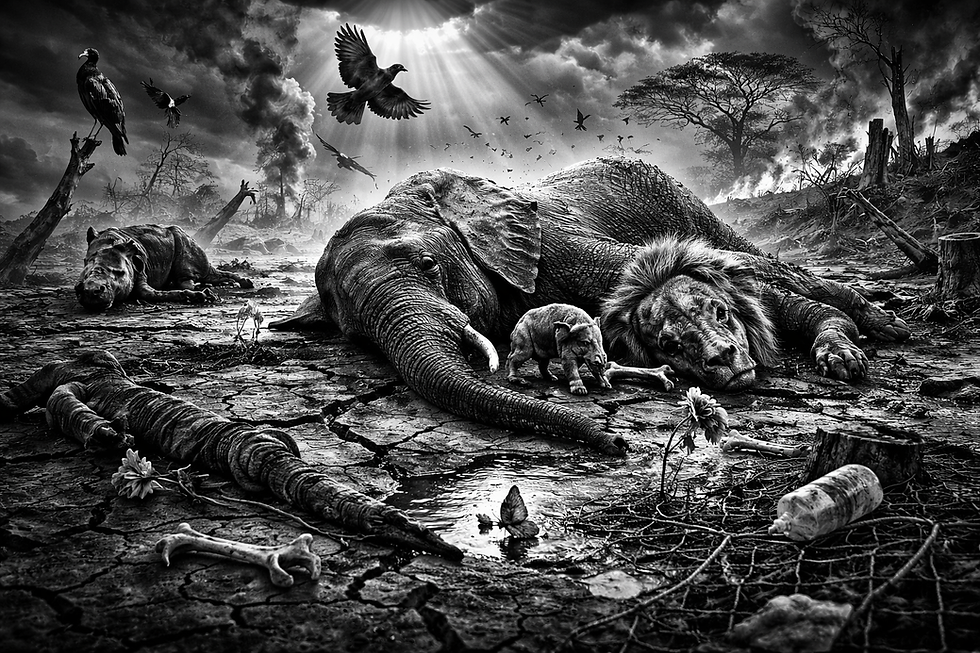
I care deeply about the environment—and the world we so casually call home, yet treat like a dumping ground. So I’ll speak plainly: we are poisoning this planet and dressing it up as something pure. We foul the very systems that sustain us, then convince ourselves everything is fine.
Of all creatures, we are the only ones that damage our own home on this scale, yet still place ourselves above everything else. That isn’t power—it’s denial. If anything is to change, it has to start with us.
Mother earth to me is a living organism that is sick, we are killing her and in return it threatens our own 'sanity' and existence. In fact we are depending on her to recover from ... US!
without us she can-not survive yet with us she can-not survive. (Like a virus) What is she to do? It's only a matter of time before we are only able to enjoy Nature on a black and white screen ...

Beauty disappearing before our square eyes. Sadly that's true and time is ticking away.
Thankfully horses are not endangered yet but think of all the species that are now on the endangered list and the ones that are already extinct. Scientists confirmed in 2018 that 3 bird species had become extinct and that about 30-50% of Earths species may disappear by 2050. Mostly caused by humans. Not long to go then? Why is this happening...
natural selection plays a huge part in a natural extinction. natural extinction is a natural process but as a species disappear because of humans, it causes all sorts of ecological problems. Disease rises in both the animal kingdom and for humans as a result. Protecting habitats is so important. if one link (species) is missing it affects other links and causes other problems, the eco system would become imbalanced, maybe even collapse. That really depends on us.

I'd hate to say goodbye to some of these amazing species, our children's children might never know what it's like to find and care for some beautiful creatures, like the hedgehog. Since the 1950's the hedgehog has declined in numbers rapidly. It's estimated that there are only one and a half million left in the UK today, from 30 million in the 50's. That's quite a decline in numbers - SHOCKING!
So many endangered species and unless it changes there is only one outcome.
Here is a list of endangered species on the British Isles (including England, Wales, Scotland, and Ireland).
I’ll include mammals, birds, plants, and insects so it’s a useful list.
Endangered Species of the British Isles
Mammals
Scottish wildcat – Critically endangered in the UK.
Red squirrel – Endangered in Britain due to grey squirrels.
Water vole – One of the fastest declining UK mammals.
European hedgehog – Vulnerable and rapidly declining in Britain.
Hazel dormouse – Vulnerable due to habitat loss.
Greater mouse-eared bat – Critically endangered in Britain.
Grey long-eared bat – Endangered.
Beaver – Endangered in Britain (though being reintroduced).
The Independent Birds
Hen harrier – Endangered due to illegal hunting.
Bittern – Rare and endangered marsh bird.
Corncrake – Endangered farmland bird.
Puffin – Declining due to climate change and food shortages.
Reptiles & Amphibians
Sand lizard – Endangered in the UK.
Natterjack toad – One of the UK’s rarest amphibians.
Insects
White-knuckled wolf spider – Critically endangered and very rare in the UK. �
The Times
Large blue butterfly – Once extinct in the UK, now reintroduced but still rare.
Plants (Very Rare British Plants)
Cotoneaster cambricus – Critically endangered plant found only in North Wales.
Wikipedia
Lady’s slipper orchid – One of the rarest UK wildflowers.
Ghost orchid – Extremely rare and sometimes thought extinct.
Summary
Many British species are endangered mainly due to:
Habitat loss
Intensive farming
Pesticides
Climate change
Pollution
Invasive species (like grey squirrels)
About a quarter of British mammals are at risk of extinction, showing how serious the situation is.

🌍 When the Earth Falls Silent

Listen closely…
Not to the noise of the world,
but to what remains when it’s gone.
Because one day—if we are not careful—
the Earth will not scream,
it will fall silent.
It won’t happen all at once.
There will be no single moment where everything stops.
No dramatic ending.
Instead, it will begin quietly.
The bees will disappear first.
Then the birdsong fades.
Forests thin, oceans empty,
and the wind carries more dust than life.
We will still wake u each morning,
still go about our days,
still tell ourselves everything is fine…
Until it isn’t.
The air will grow heavier.
Harder to breathe.
Not because it’s gone—
but because it’s no longer alive.
The skies will change too.
Less blue.
More grey.
More angry.
Storms will come stronger.
Heat will linger longer.
Cold will bite deeper.
And the seasons—once our rhythm—
will forget their place.
Food will become scarce.
Water, uncertain.
The land that once fed us
will struggle to feed itself.
And for the first time,
humanity will realise something it has long ignored:
We were never separate from nature.
We were part of it.
And without it—
we are nothing.
We will try to adapt.
Build walls.
Create domes.
Hide underground.
Small pockets of survival
in a world that no longer welcomes us.
But survival is not living.
And then… the silence deepens.
No insects.
No birds.
No movement in the trees.
Just wind,
moving through a world we once called home.
The Earth will remain.
It will keep spinning.
The oceans may still rise and fall.
But it will no longer be alive
in the way we understand it.
Not because it chose to die—
but because we forgot how to let it live.
So listen now—while you still can.
To the birds.
To the breeze.
To the quiet hum of life all around you.
Because one day,
if nothing changes…
those will become memories.
And the greatest tragedy of all?
It didn’t have to end this way.

🌍 Climate Change Explained Simply
Have you ever wondered why the Earth is getting warmer? Here's an easy way to understand it.
Imagine you're tucked up in bed.
On a cold night, one blanket keeps you warm. But if someone keeps piling more and more blankets on top of you, you soon become too hot.
The Earth is a bit like that.
Around our planet is a layer of air called the atmosphere. It acts like a blanket, keeping enough warmth in for people, animals and plants to live.
For a very long time, that blanket stayed about the right thickness.
But over the last couple of hundred years, people have burned lots of coal, oil and gas, cut down forests, and produced more greenhouse gases. Greenhouse gases are invisible gases in the air, such as carbon dioxide (CO₂) and methane. These gases trap some of the Sun's heat and stop it from escaping back into space.
A small amount of these gases is natural and helps keep the Earth warm enough for life. But as more greenhouse gases build up, the Earth's blanket becomes thicker.
A thicker blanket traps more heat, so the planet slowly becomes warmer.
That extra warmth can lead to:
🌡️ Hotter summers and more heatwaves.
🌧️ Heavier rain and flooding in some places.
🌵 Drier weather and droughts in others.
🧊 Melting ice at the North and South Poles.
🌊 Rising sea levels.
The Earth has always gone through natural changes over millions of years, but today many scientists believe that human activities are adding to the warming much faster than nature alone would.
Our planet is the only home we all share. Whether we agree on every detail or not, looking after the air, water, forests and wildlife is something that benefits everyone—and future generations too.
Every generation inherits the Earth from the one before it. The more we understand our world, the better equipped we are to care for it—for ourselves, for wildlife, and for the generations still to come.

Comments