


South America

South America – A Land of Wonders
South America is a continent of extraordinary contrasts, stretching from tropical rainforests and vast wetlands to towering mountains and windswept plains. Home to the mighty Amazon Rainforest, the Andes Mountains, and some of the most unique wildlife on Earth, it is a land where nature still reigns supreme.
Separated from other continents millions of years ago, South America became a sanctuary for remarkable species found nowhere else. Jaguars stalk through dense jungle, colourful macaws soar above the rainforest canopy, sloths move slowly through the treetops, and pink river dolphins glide through the waters of the Amazon.
The Amazon Rainforest, often called the "lungs of the Earth," contains an astonishing variety of plants and animals and plays a vital role in regulating the planet's climate. Alongside this natural richness, South America is also home to ancient cultures and civilisations that have lived in harmony with the land for thousands of years.
From the snow-capped peaks of the Andes to the depths of the Amazon Basin, South America remains one of the most biodiverse and fascinating places on our planet—a continent of beauty, mystery, and life.

Sloth
The sloth is one of South America's most unusual and recognisable animals. Found in the tropical rainforests of Central and South America, sloths spend most of their lives hanging upside down in the trees, rarely coming down to the forest floor.
Despite their reputation for being lazy, sloths move slowly for a good reason. Their diet consists mainly of leaves, which provide very little energy. By moving carefully and conserving energy, they can survive on a surprisingly low-calorie diet.
Sloths are excellent climbers and spend much of their time sleeping, often resting for up to 15–20 hours a day. Their long claws help them grip branches securely, allowing them to hang comfortably high above the ground.
One of the most fascinating features of a sloth is its fur. Algae often grows on the coat, giving it a greenish tint that helps camouflage it among the rainforest trees. This unique partnership helps protect sloths from predators such as jaguars and harpy eagles.
Although they may appear slow and relaxed, sloths are perfectly adapted to life in the rainforest and play an important role in maintaining the health of their ecosystem.
Conservation Status: Most sloth species are not currently endangered, but habitat loss and deforestation continue to threaten their future.

Jaguar
The jaguar is the largest cat in South America and one of the most powerful predators in the Americas. Found in tropical rainforests, wetlands, and grasslands, jaguars are most closely associated with the Amazon Rainforest, where they play a vital role in maintaining the balance of the ecosystem.
Unlike many big cats, jaguars are excellent swimmers and are often found near rivers and lakes. They hunt a wide variety of prey, including fish, turtles, capybaras, deer, and caimans. Their powerful jaws give them the strongest bite of any big cat relative to their size, allowing them to crush the skulls and shells of their prey.
Jaguars are solitary animals, spending most of their lives alone except during the breeding season. Each jaguar has a unique pattern of rosettes on its coat, much like a human fingerprint.
For thousands of years, jaguars have been respected and feared by many Indigenous cultures of South America, often symbolising strength, courage, and power.
Today, jaguars face increasing threats from habitat loss, deforestation, and conflict with humans. Protecting the rainforests and wetlands they depend on is essential for their survival.
Conservation Status: Near Threatened

Pink River Dolphin
The Pink River Dolphin, also known as the Boto, is one of the most unusual and fascinating animals found in South America. Living in the rivers, lakes, and flooded forests of the Amazon and Orinoco river basins, it is the largest species of river dolphin in the world.
Unlike ocean dolphins, pink river dolphins have flexible necks that allow them to move their heads from side to side. This helps them navigate through submerged trees and dense vegetation during the rainy season when large areas of forest become flooded.
Their distinctive pink colour becomes more noticeable as they age and can vary from pale grey-pink to bright pink. Scientists believe the colour is influenced by age, activity, and blood flow near the skin.
Pink river dolphins use echolocation to find their way through the often murky waters of the Amazon. By producing clicking sounds and listening to the echoes, they can locate fish, turtles, and other prey even when visibility is poor.
These intelligent mammals have inspired many legends among Indigenous peoples of the Amazon. One of the most famous stories tells of the boto transforming into a handsome man at night and returning to the river before dawn.
Today, pink river dolphins face threats from pollution, habitat destruction, fishing nets, and changes to river systems. Protecting the Amazon's waterways is essential for the survival of this remarkable species.
Conservation Status: Endangered
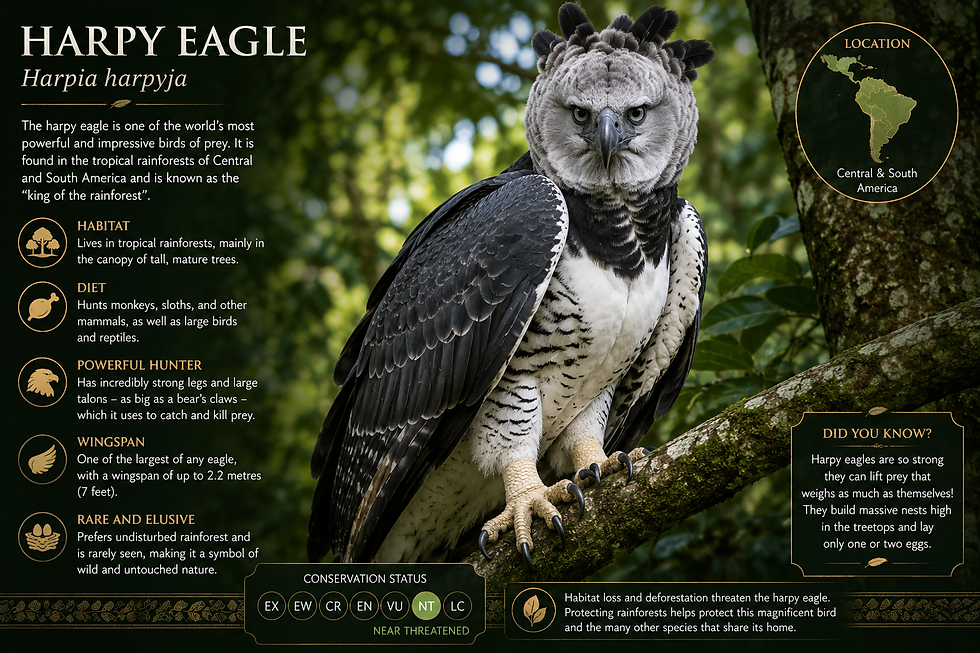
Harpy Eagle
The Harpy Eagle is one of the largest and most powerful birds of prey in the world. Found in the tropical rainforests of Central and South America, it spends most of its life high in the forest canopy, where it reigns as one of the rainforest's top predators.
Unlike eagles that soar over open landscapes, the Harpy Eagle is specially adapted for life among the trees. Its short, broad wings allow it to manoeuvre through dense rainforest, while its powerful legs and enormous talons help it capture prey with incredible force.
Harpy Eagles feed mainly on tree-dwelling animals such as sloths and monkeys, although they will also hunt birds, reptiles, and other mammals. Their talons can grow larger than a grizzly bear's claws and are strong enough to lift prey weighing almost as much as the eagle itself.
One of the eagle's most striking features is its owl-like face. The feathers around its head help direct sound towards its ears, allowing it to locate prey hidden among the rainforest foliage. When alarmed or excited, it can raise the feathers on its head into a dramatic crest.
Harpy Eagles build enormous nests high in the tallest trees and may use the same nest for many years. Females usually lay only one or two eggs, making population recovery slow when numbers decline.
Today, habitat loss and deforestation threaten Harpy Eagle populations across much of their range. Protecting the rainforests of South America is essential for the survival of this magnificent bird.
Conservation Status: Near Threatened

Scarlet Macaw
The Scarlet Macaw is one of the most colourful and recognisable birds in South America. Found in the tropical rainforests of the Amazon and other forested regions, these magnificent parrots are known for their brilliant red, blue, and yellow feathers.
Scarlet Macaws are highly intelligent and social birds. They often live in pairs or small groups and communicate using loud calls that can be heard across the rainforest. Mated pairs form strong bonds and may remain together for life.
Their powerful curved beaks are perfectly adapted for cracking open hard nuts and seeds, while their agile feet allow them to climb and handle food with remarkable skill. They also feed on fruits, berries, flowers, and leaves found throughout the rainforest.
Macaws play an important role in maintaining healthy forests. As they travel through the rainforest, they disperse seeds in their droppings, helping new plants and trees grow. Because of this, they are sometimes called the "gardeners of the rainforest."
Sadly, Scarlet Macaws face threats from habitat loss, deforestation, and the illegal pet trade. Protecting the rainforests of South America helps ensure these beautiful birds continue to thrive in the wild.
With their striking colours, intelligence, and strong family bonds, Scarlet Macaws are among the most spectacular ambassadors of the Amazon rainforest.
Conservation Status: Least Concern (though local populations remain under pressure from habitat loss and illegal capture).

Reflection
South America is one of the most diverse and extraordinary places on Earth. Within its vast rainforests, winding rivers, and towering mountains lives an incredible variety of wildlife, each species perfectly adapted to its own corner of the natural world.
From the slow-moving sloth hidden among the treetops to the powerful jaguar stalking the forest floor, from the mysterious pink river dolphin navigating the waters of the Amazon to the mighty harpy eagle soaring above the canopy, life flourishes in every layer of the rainforest. Adding colour and song to this rich ecosystem, scarlet macaws fill the skies with their brilliant feathers and unmistakable calls.
The Amazon Rainforest is often described as the "lungs of the Earth," producing oxygen, storing carbon, and supporting millions of species of plants and animals. Yet this remarkable environment faces increasing threats from deforestation, habitat loss, pollution, and climate change.
Protecting South America's wild places is about more than saving individual species. It is about preserving one of the most important ecosystems on our planet, ensuring that future generations can continue to experience the beauty, wonder, and diversity of a continent where nature still thrives on a truly extraordinary scale.
South America reminds us that every creature, whether great or small, has its place in the web of life. Together they form a living tapestry that has evolved over millions of years and deserves our respect, admiration, and protection.
Comments