


The Majestic Raven.

Ravens carry an ancient beauty that feels both wild and wise, as if they belong to a world just beyond our own. With their deep, ink-black feathers that shimmer blue in the light, and their intelligent, watchful eyes, they move with a quiet confidence through sky and shadow. Their calls echo like forgotten voices across the land, and their presence has long been woven into myth, magic, and mystery. To watch a raven is to glimpse something timeless—an elegant creature that embodies both the majesty of nature and the secrets of the unseen world.
Fun Facts ...
Ravens are among the smartest animals on Earth. Studies show they can solve complex problems, use tools, and even plan for the future—abilities once thought to belong only to humans and primates.
🗣️ They can mimic sounds.
Like parrots, ravens can imitate noises they hear—including human speech, other birds, and even mechanical sounds like engines or camera clicks.
🎭 They play games
Ravens have been observed sliding down snowy roofs, rolling in the air, and playing “catch” with sticks—just for fun!
👀 They recognise faces
Ravens can remember human faces and will react differently depending on whether they see you as friendly or a threat. And yes… they can hold grudges.
🧩 They solve puzzles
In experiments, ravens have figured out multi-step puzzles to get food rewards—sometimes faster than young children.
💍 They mate for life
Ravens usually form strong lifelong bonds with their partners and often work together to raise their young.
⚰️ They hold “funerals”
When a raven finds a dead raven, others may gather around, calling loudly. Scientists believe this helps them learn about dangers in the area.
🌍 They are found worldwide
Ravens live across the Northern Hemisphere, from the wilds of Canada to the mountains of Wales, adapting to forests, cliffs, and even cities.
🖤 Deep roots in mythology
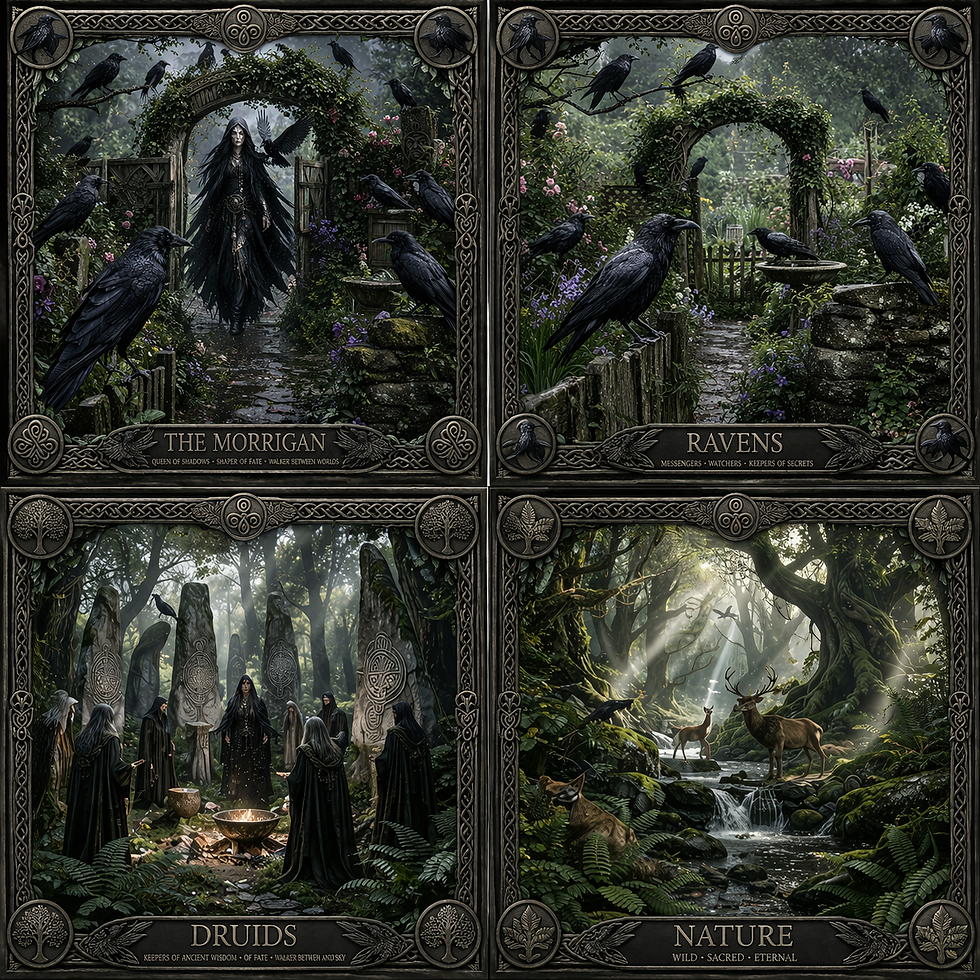
Ravens appear in many myths and legends. In Celtic lore, they are often linked to The Morrigan, symbolising fate, battle, and transformation.
🧭 They communicate cleverly
Ravens don’t just caw—they use a wide range of sounds and gestures to communicate complex ideas with each other.

The raven usually means the Common Raven (Corvus corax), a large black bird in the crow family. It’s one of the largest songbirds/perching birds, found across much of the Northern Hemisphere, and it’s known for being extremely intelligent, adaptable, and omnivorous. fws.gov allaboutbirds.org
A few quick facts:
Scientific name: Corvus corax. fws.gov
Family: Corvidae, the same family as crows, jays, and magpies. allaboutbirds.org
Diet: They eat a wide mix of foods—carrion, insects, grains, eggs, small animals, and human food waste. nationalgeographic.com allaboutbirds.org
Behavior: Ravens are famous problem-solvers and can learn cause and effect. They’re also strong, acrobatic fliers. allaboutbirds.org nationalgeographic.com
Social life: Breeding pairs tend to hold territories, while in winter younger ravens may gather in groups around food sources. allaboutbirds.org nationalgeographic.com
Nesting: They often build large stick nests and, in natural settings, commonly nest on cliffs, though they can adapt to human-built structures too. allaboutbirds.org
Ravens also do well around people when conditions suit them. A recent example is at Concordia University’s Loyola Campus, where a breeding pair has nested on the Psychology Building. The university linked that to a growing urban ecosystem supported by tree planting, no-mow zones, gardens, and other biodiversity efforts. concordia.ca
One common point of confusion: “raven” can refer to several species in the genus Corvus, but in North America people usually mean the Common Raven. en.wikipedia.org fws.gov

The raven’s ancestry stretches back through millions of years to the age of the dinosaurs. Modern ravens belong to the bird family known as corvids, whose ancient ancestors evolved from small feathered dinosaurs that survived the asteroid impact which wiped out most dinosaur species around 66 million years ago. Over vast periods of time, these survivors adapted and evolved into early birds, eventually giving rise to intelligent species such as ravens, crows, and magpies.
Ravens carry traces of this ancient lineage in their sharp eyesight, complex social behaviour, problem-solving intelligence, and strong survival instincts. Their DNA links them to one of the oldest surviving branches of life on Earth, making them living descendants of prehistoric creatures that endured mass extinction, climate change, and the transformation of the planet itself.
Perhaps this is why ravens have fascinated humanity for thousands of years, appearing in mythology, folklore, and spiritual symbolism across many cultures. They are not only birds of mystery and intelligence, but also ancient survivors whose story reaches back to the dawn of the modern world.

"Mysterious, intelligent, and deeply woven into myth, ravens are far more than simple birds—they are watchers, messengers, and keepers of ancient secrets.”

🏰 The Ravens of the Tower of London
🖤 The Legend
The story goes:
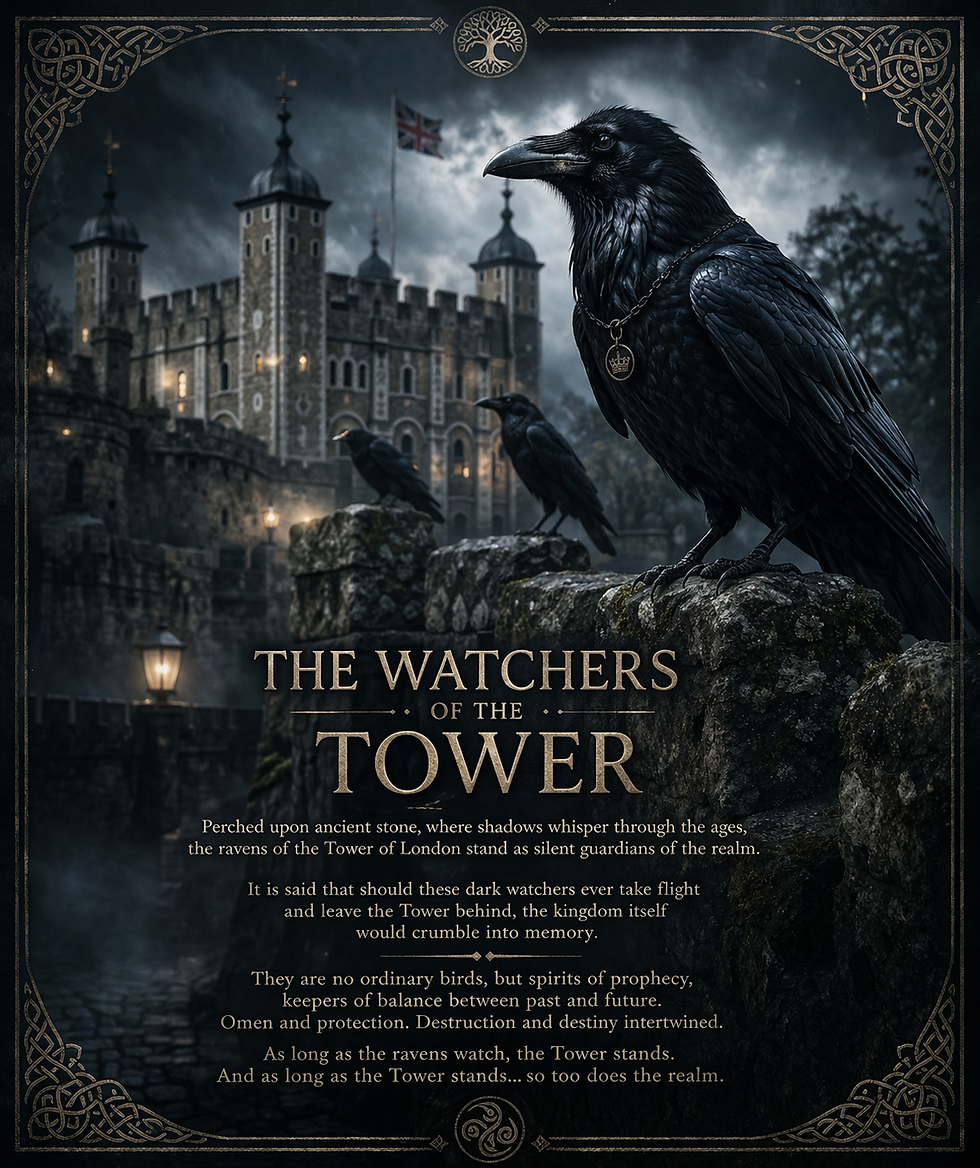
If the ravens ever leave the Tower, the kingdom will fall.
According to tradition, the Crown—and even Britain itself—depends on the ravens staying there. No one knows exactly when the legend began, but it’s often linked to the time of King Charles II in the 17th century.
👑 Why Are They Still There?
It’s said that Charles II was warned (possibly by a court astrologer) that disaster would strike if the ravens left. Rather than risk it, he ordered that at least six ravens must always be kept at the Tower.
Today:
There are usually 6-8 ravens living there
They are cared for by a special Yeoman Warder called the Ravenmaster
Their wings are sometimes partially clipped to discourage them from flying too far
🧙♀️ A Touch of Mystery
Ravens have long been tied to myth and magic:
In Celtic lore, they’re linked to figures like The Morrígan, a goddess of war and fate
They’re often seen as guardians, messengers, or omens
So the Tower’s ravens feel like more than just birds—they’re almost like watchers of history, protecting the realm.

Comments