


Celtic Mythology.
Updated: Jun 9

🌿 Celtic mythology is deeply rooted in the natural world, where every tree, river, and stone was believed to hold spirit and meaning. For the ancient Celts, nature was not separate from life—it was life itself, alive with unseen forces and divine presence.
Forests were especially sacred. Druids, the spiritual leaders of Celtic societies, often held ceremonies in woodland groves, believing these places were gateways between worlds. Trees such as the oak, ash, and yew were revered, each carrying symbolic power—strength, wisdom, and eternal life.
Rivers and springs were also honoured as living entities. Many were associated with goddesses who embodied healing, fertility, and renewal. Offerings were often left at these waters, a quiet exchange between human and spirit.
Animals played an equally powerful role. Creatures like stags, wolves, and ravens were seen as messengers or guides, moving between the physical and spiritual realms. Their presence was never accidental—it carried meaning, a whisper from the unseen.
In Celtic mythology, nature is not just a backdrop but a sacred partner. It teaches balance, respect, and connection—a reminder that humanity is woven into the same living tapestry as the earth itself.
The Morrígan and Her Ravens — A Gentle Tale of Shadow and Sky.

In the quiet spaces between earth and sky, where mist rolls gently over green hills, the Morrígan is not always the dark figure of war she is often made out to be. Instead, she can be seen as a guardian of nature’s balance, walking softly alongside her companions—the ravens.
These glossy black birds, often misunderstood, were never just symbols of death. To the Morrígan, they were watchers, messengers, and protectors. Their keen eyes saw what others missed, their wings carried whispers on the wind, and their presence reminded the world that every ending is simply a beginning in disguise.
Rather than bringing fear, the Morrígan and her ravens can be seen as guides through change. Just as the seasons turn and the land renews itself, they teach us to embrace transformation with courage. A raven landing nearby might not be an omen of darkness—but a quiet nudge to trust the path ahead.
In this softer light, the Morrígan becomes something more comforting:
a keeper of cycles, a protector of the wild, and a reminder that even in shadow, there is wisdom, beauty, and peace.
And if you ever see a raven watching you from a branch or soaring high above, perhaps it’s not something to fear at all—
but a gentle sign that you are being watched over, guided, and never truly alone. 🖤

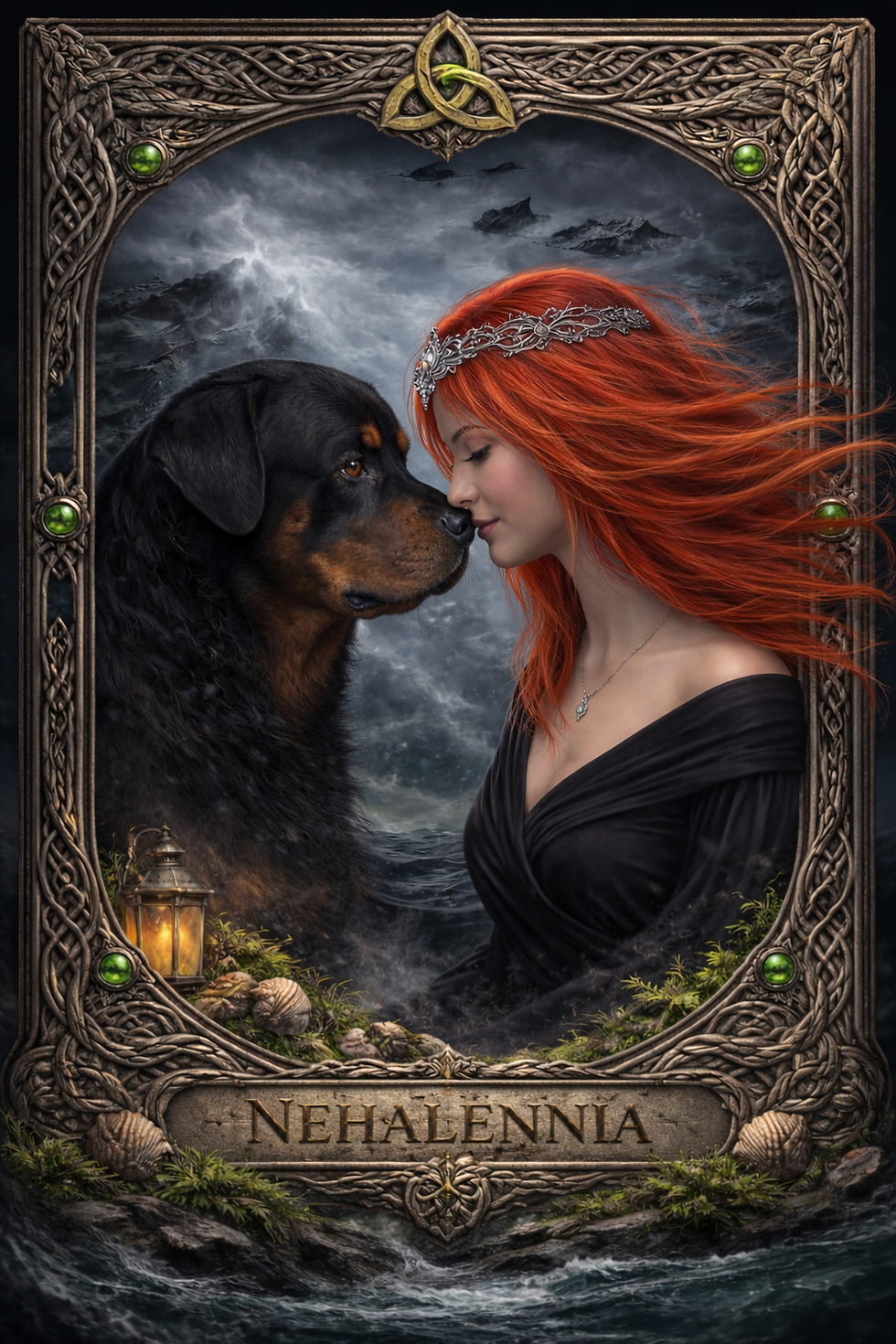
Nehalennia is an ancient Celtic goddess of protection, travel, and safe passage, especially across the sea. Worshipped along the coastal regions of what is now the Netherlands, she is often depicted with a loyal dog at her side and symbols of abundance such as fruit and baskets. As a guardian of journeys, she represents both physical and spiritual guidance—watching over those who venture into the unknown and offering calm, protective strength in times of uncertainty.
Nehalennia’s connection to dogs reflects her role as a gentle yet powerful protector. In many carvings and altars, a dog sits faithfully at her side, symbolising loyalty, guardianship, and guidance. In Celtic belief, dogs were often seen as protectors of the soul and companions between worlds, able to sense what humans cannot. With Nehalennia, the dog represents a calm, watchful presence—one that guards travellers not only on physical journeys across land and sea, but also through unseen, spiritual paths. Together, they embody trust, protection, and the quiet strength of a guide who never leaves your side.

🌙 Gwyn ap Nudd – Keeper of the Veil
Gwyn ap Nudd is the shadowed king of Annwn, a guardian of the unseen world who walks the thin line between life and death. Cloaked in mist and myth, he leads the Wild Hunt across storm-dark skies, guiding restless spirits and maintaining the balance between realms.
The Lord of the Otherworld
Gwyn ap Nudd is not a figure of fear, but of necessity—a quiet ruler of endings, thresholds, and transformation. As lord of Annwn, he holds dominion over wandering souls, ensuring they do not spill into the world of the living and disrupt its fragile harmony. His presence is felt in the hush of winter forests, in the echo of distant howls carried on the wind, and in the turning of the seasons when life retreats and the earth grows still. Leader of the spectral hunt, accompanied by the otherworldly hounds known as the Cŵn Annwn, Gwyn rides through the night as both guardian and guide. His eternal struggle with light and summer reflects the balance of nature itself—darkness giving way to light, and light inevitably returning to shadow. In this way, Gwyn ap Nudd is not merely a ruler of the dead, but a keeper of cycles, a watcher at the veil, and a reminder that even in darkness, there is purpose and order.

🌿 Y Galon Werdd – The Green Heart
Deep within the living forest, where light filters gently through ancient leaves, the spirit of the Green Man endures. He is the quiet guardian of growth, renewal, and balance—woven into root, branch, and breath.
This space honours the beauty of nature in all its forms, reminding us that we are not separate from the earth, but part of its living story.
🌿 Y Galon Werdd
Yn nyfnder y goedwig hynafol, lle mae’r golau’n pylu drwy’r dail a’r cysgodion yn dawnsio’n araf, erys ysbryd y Dyn Gwyrdd. Ef yw ceidwad distaw cylch bywyd—y tyfiant, y darfod, a’r adfywiad—wedi’i rwymo i wreiddiau’r ddaear ac i anadl y gwyntoedd.
Yma y cedwir hen wybodaeth y tir, wedi’i guddio ym mhob deilen a cherrig mud y goedwig. Nid ydym ond gwesteion dros dro, wedi’n galw i gofio ein lle o fewn y cylch tragwyddol.

Comments