


Rhiannon the Enigmatic Horse Goddess

Rhiannon is a central figure in Welsh mythology, best known from the Mabinogion. She is a mysterious and powerful woman often associated with horses, the Otherworld, and quiet authority. Rhiannon first appears as an otherworldly presence who cannot be caught when pursued, symbolising independence and control over her own path. She later chooses to marry Pwyll, showing that her power lies not in force, but in choice. Throughout her story, she endures false accusations and hardship with remarkable calm and dignity, making her a lasting symbol of strength, patience, and inner resilience.

Rhiannon, drawn from the ancient Welsh tales of the Mabinogion, can be understood not only as a mythological figure but as a powerful psychological archetype—one that represents inner sovereignty, emotional endurance, and the quiet strength of self-possession. Unlike many figures in myth who act through force or drama, Rhiannon’s power lies in her stillness; she cannot be captured when chased, suggesting a mind that cannot be controlled by urgency, fear, or external pressure. Psychologically, this reflects a state of deep inner regulation—the ability to remain grounded when others are reactive. Her choice to unite with Pwyll shows autonomy and discernment, reinforcing the idea that true power comes from choosing rather than being chosen. Perhaps most striking is her response to false accusation and punishment: rather than breaking, retaliating, or collapsing under injustice, she endures with dignity, carrying the weight of shame imposed upon her without internalising it. This speaks to a profound psychological resilience—the capacity to experienRhiannon is one of the most captivating figures in Welsh mythology, a goddess of horses, sovereignty, and the Otherworld. Her story, preserved in the ancient tales of the Mabinogion, paints her as both powerful and deeply mysterious.
Rhiannon first appears as a radiant woman riding a white horse, moving with an unearthly calm. Though others chase her, she cannot be caught—symbolising her connection to the supernatural and the idea that true power cannot be forced or possessed. When she chooses her own path, she does so with quiet authority, selecting her destiny rather than allowing others to decide it.
Often associated with horses, Rhiannon represents freedom, grace, and strength. In Celtic culture, horses were symbols of sovereignty and the land itself, linking her to rulership and the natural world. She is also connected to magical birds whose song could soothe the living or awaken the dead, hinting at her ties to both life and the Otherworld...
Yet her story is not without hardship. Wrongly accused of a terrible crime, Rhiannon endures punishment with dignity and patience, embodying resilience and inner strength. In time, the truth is revealed, and her honour is restored—reinforcing themes of justice and endurance.
Rhiannon remains a powerful symbol of feminine strength, independence, and harmony with nature—a timeless figure who rides between worlds, carrying the quiet magic of the Celtic lands.ce suffering without losing identity. In modern terms, Rhiannon embodies what we might call emotional sovereignty: she does not allow external chaos to define her internal state. Her connection to horses and the Otherworld further deepens this interpretation, symbolising instinct, freedom, and the unconscious mind—suggesting she moves fluidly between awareness and intuition. Where figures like Blodeuwedd represent consequence and transformation through rupture, Rhiannon represents transformation through endurance and return. She is the psyche that has been tested, misunderstood, and burdened, yet remains intact—unchanged at its core. In this way, Rhiannon is not just a figure of myth, but a mirror for anyone who has learned, often the hard way, that strength is not always loud, and that sometimes the most powerful thing a person can do is remain unmoved when the world expects them to fall.
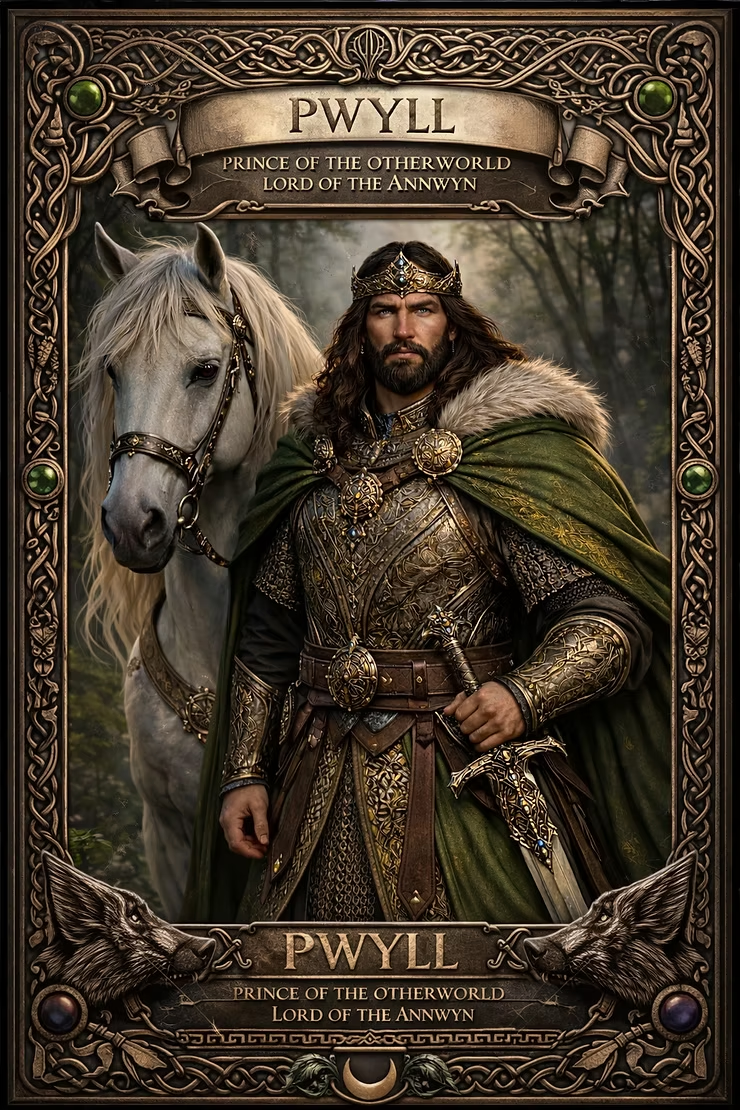
Rhiannon and Pwyll share one of the most enchanting and symbolic relationships in the Mabinogion. Rhiannon, a mysterious and otherworldly woman often linked to horses and the Otherworld, first appears riding a magical white horse that no one can catch—until Pwyll calls out to her rather than chasing.
Their meeting is no accident. Rhiannon chooses Pwyll as her husband, revealing both her independence and wisdom. She helps him overcome obstacles, including her forced marriage to another man, showing strength and cleverness.

Rhiannon is one of the most compelling and sophisticated figures in Welsh mythology. Appearing primarily in the First and Third Branches of the Mabinogi, she is a woman of immense willpower, patience, and supernatural origins.
While often labelled a "queen," her characteristics strongly suggest she is a euhemerized (humanized) version of an ancient Celtic horse goddess, likely related to the Gaulish Epona.
1. Key Myths and Legends
The Great Chase (First Branch)
Rhiannon makes an unforgettable entrance. Pwyll, the Prince of Dyfed, sees her riding a pale white horse. Despite her horse appearing to move at a slow, steady pace, neither Pwyll nor his fastest riders can catch her.
The Lesson: Pwyll eventually realizes that physical force won't work and simply asks her to stop. She famously retorts:
"I will stop gladly... and it would have been better for your horse had you asked long ago."
The False Accusation
After marrying Pwyll, Rhiannon gives birth to a son who mysteriously vanishes in the night. To avoid blame, her maids kill a puppy, smear its blood on the sleeping Rhiannon, and claim she ate her own child.
The Penance: Rather than fighting the claim with violence, Rhiannon accepts a grueling penance: for seven years, she sits by the gate of the castle, offering to carry guests on her back like a beast of burden.
The Resolution: The child is eventually found and restored to her. She names him Pryderi (meaning "worry" or "care"), signifying the end of her ordeal.
The Golden Bowl (Third Branch)
Later in life, after Pwyll's death, Rhiannon marries Manawydan. In a surreal sequence, she and Pryderi are trapped by a magical enchantment after touching a golden bowl in a mysterious fortress. They are eventually rescued by the wit and patience of Manawydan, showing her vulnerability to the supernatural forces of the "Otherworld."
2. Symbolic Attributes
Rhiannon is defined by several iconic symbols that hint at her divine origins:
The White Horse: She is inextricably linked to her mount, which possesses supernatural speed and grace.
The Birds of Rhiannon: In legend, she possesses three magical birds whose song can "wake the dead and lull the living to sleep."
The Bag of Infinite Capacity: During her wedding feast, she helps Pwyll outwit a rival (Gwawl) using a small magic bag that can never be filled, no matter how much food or many people are put inside.
3. Character Analysis
Rhiannon is often celebrated by modern scholars for her sharp wit and stoicism. In a male-dominated heroic cycle, she stands out because:
She chooses her own husband: She rejects the suitor her father chose for her to pursue Pwyll.
She is the brains of the operation: She frequently has to guide Pwyll through his own blunders.
She endures injustice: Her period of penance is seen as a testament to her dignity and strength under pressure.
Comments