


The Ancient Celts
Updated: Jul 7

The early Celts, who emerged from central Europe and spread across regions such as the Rhine, Gaul, and eventually into Britain and Ireland, shared a way of life deeply rooted in nature, movement, and connection. They believed the world was alive with spirit — in rivers, trees, animals, and the land itself — a view often described as animistic. Rather than seeing life as a straight path, they understood it as a loop, a cycle of change, where birth, death, and renewal were all part of the same continuous flow. Across different Celtic regions, similar patterns appear: powerful female figures linked to the land, symbols like spirals and knots representing eternity and connection, and animals such as horses and ravens acting as guides between worlds. Although these cultures were spread across wide areas and were not one single people, their beliefs shared a common thread — that everything is interconnected, always moving, and never truly separate.

Celtic symbols are far more than decorative designs; they are visual expressions of how the ancient Celts understood life and the world around them.
Patterns such as spirals and interwoven knots reflect a belief in movement, continuity, and the deep connection between all things. The spiral, one of the oldest symbols, represents growth, cycles, and the journey of life — always unfolding, never truly ending. Celtic knots, with no clear beginning or end, symbolise eternity and the idea that everything is linked: past and !present, life and death, people and nature. These symbols often draw inspiration from the natural world, echoing the Celtic belief that the land, animals, and unseen forces all held meaning and presence. Rather than separating the physical and spiritual, Celtic symbolism weaves them together, suggesting that life is not a straight path, but a continuous flow of change, connection, and renewal.

The Celtic languages go back a very long way—much further than written history on the British Isles.
Celtic languages have been around for over 2,500–3,000 years.

🌍 Where they began
They developed from a branch of the wider Indo-European languages family, probably somewhere in central Europe around:
1200–800 BC (Late Bronze Age / early Iron Age)
From there, Celtic-speaking peoples spread across much of Europe.
🗺️ The early Celts
By around 500 BC, Celtic languages were spoken across a huge area:
France (Gaul)
Spain
parts of Germany
the Alps
and eventually the British Isles
🏝️ In Britain and Ireland
Celtic languages reached Britain and Ireland roughly:
around 800–500 BC
Over time, they developed into the languages you recognise more today:
Welsh
Irish (Gaeilge)
Scottish Gaelic
Breton (in France)
🌙 Old vs modern Celtic
There are two main stages:
🪨 Ancient Celtic (now lost)
Spoken across Europe
Includes languages like Gaulish
Mostly disappeared after Roman expansion
🌿 Modern Celtic (still alive)
Welsh
Irish
Scottish Gaelic
Breton
👉 These are the surviving branches
Welsh comes from a branch of Celtic called Brythonic (also called Brittonic).
This split from the wider Celtic family as tribes settled in Britain around 800–500 BC.

🪨 Stage 1: Common Brittonic (Ancient Britain)
Spoken across most of Britain before the Romans
No written form at first — passed down orally
Ancestor of:
Welsh
Cornish
Breton
👉 This is the language your earliest British Celts would have spoken
🏛️ Stage 2: Roman Britain influence (43–410 AD)
During Roman rule:
Latin words filtered into the language
But Celtic speech survived strongly, especially in the west (Wales)
👉 This is why Welsh still feels ancient — it wasn’t replaced
🌄 Stage 3: Old Welsh (around 600–900 AD)
This is where Welsh becomes recognisable as its own language.
First written forms appear
Used in early poetry and law
Still quite different from modern Welsh
📜 Stage 4: Middle Welsh (1100–1400)
This is the language of the Mabinogion — where Rhiannon’s story comes from.
Much closer to modern Welsh
Rich in storytelling, mythology, and poetry
Considered a golden age of Welsh literature
👉 This is the heart language of your site themes
🌿 Stage 5: Modern Welsh (1500 → today)
Standardised over time
Still spoken today (especially in Wales)
Has evolved, but still carries ancient roots
🌙 Why Welsh is special
Unlike many ancient languages:
It never fully died out
It adapted, but kept its core identity
It’s one of the oldest continuously spoken languages in Europe
💡 A beautiful way to see it
Welsh isn’t just old…
It’s a language that has:
survived invasion
adapted through time
and still carries echoes of the ancient world
Ogham Writing

“Some names were never written into history, yet carried through generations, rooted in land and memory.”
Ogham is an early form of writing used by Celtic-speaking peoples, most strongly associated with Ireland, and dating from around the 4th to 6th centuries AD. It consists of simple lines or notches carved along the edge of standing stones, forming an alphabet that was used mainly to record personal names and family lineage. Ogham developed during a time when the spoken Celtic languages were beginning to be written down, possibly influenced by contact with Latin during the Roman period, yet it retained a distinct and native character. While most examples are found in Ireland, a number also appear in western Britain, including Wales, showing the shared cultural links across Celtic regions. The stones were typically used as memorial markers, quietly preserving identity rather than telling stories. As Latin writing became more dominant, Ogham gradually fell out of everyday use, but it was not entirely lost. Medieval scholars recorded and preserved the script in manuscripts, allowing it to survive beyond its original period. Today, Ogham remains one of the earliest physical traces of written Celtic language, a simple yet enduring system that bridges the gap between spoken tradition and recorded memory.
🌿 “Marks, Voice, and Meaning”

Long before language was written, it was carried — spoken, remembered, and shaped by those who lived close to the land. In the Celtic world, meaning was not held in one form alone, but across different expressions, each preserving something essential.
Ogham stands as one of the earliest physical traces of this transition. Carved into stone between the 4th and 6th centuries, its simple lines marked identity — a name, a lineage, a presence set into the earth. It did not tell stories, but it ensured that someone was remembered.
Alongside this, there existed the voice — the spoken word. Stories, poetry, and memory were passed from one generation to the next, long before they were written in texts such as the Mabinogion. These were not fixed, but living, shaped by time and retelling.
Then there were the symbols — spirals, knots, and patterns carved into stone and drawn into manuscripts.
They spoke without words, expressing cycles, connection, and continuity. A language not read, but felt.
Together, they form a whole:
the mark — carved into stone
the voice — carried through memory
the meaning — held in symbol
Not separate, but connected. Not lost, but transformed.
🪨 Early stone inscriptions (Roman Britain & Celtic areas)
6
After (and alongside) Ogham, people in Britain and Wales began carving:
Latin inscriptions into stone
often with crosses as Christianity spread (around 400–700 AD)
👉 These sometimes appear on the same stones as Ogham
So you get this moment in time where:
Ogham = older, native identity
Latin = newer influence
👉 It’s like two worlds meeting on the same stone
🌿 Early Welsh poetry (spoken before written)
Before writing was common, the Celtic world relied on oral tradition.
Poems, stories, and names were memorised and passed down
Later written in manuscripts like the Mabinogion
👉 This is the voice behind Ogham— the part that wasn’t carved, but remembered
🌀 Celtic symbols & knotwork
7
These aren’t “writing” in the same way, but they carry meaning:
spirals (like the triskele)
endless knots
repeating patterns
👉 They represent:
cycles
continuity
connection
Almost like a language without words
🌲 Tree lore (linked to Ogham)
There’s also a later tradition (recorded in medieval texts) that connects Ogham letters to trees:
Oak
Birch
Willow
👉 Whether this was original or added later is debated, but symbolically it fits:
language tied to nature
meaning rooted in the land
🌙 Why Ogham still stands apart
Here’s the honest truth:
It’s one of the only native writing systems of the early Celtic world
It sits right at the point where:
spoken memory
becomes carved identity
👉 That’s why it feels so powerful — it’s a transition moment
Celtic Warriors
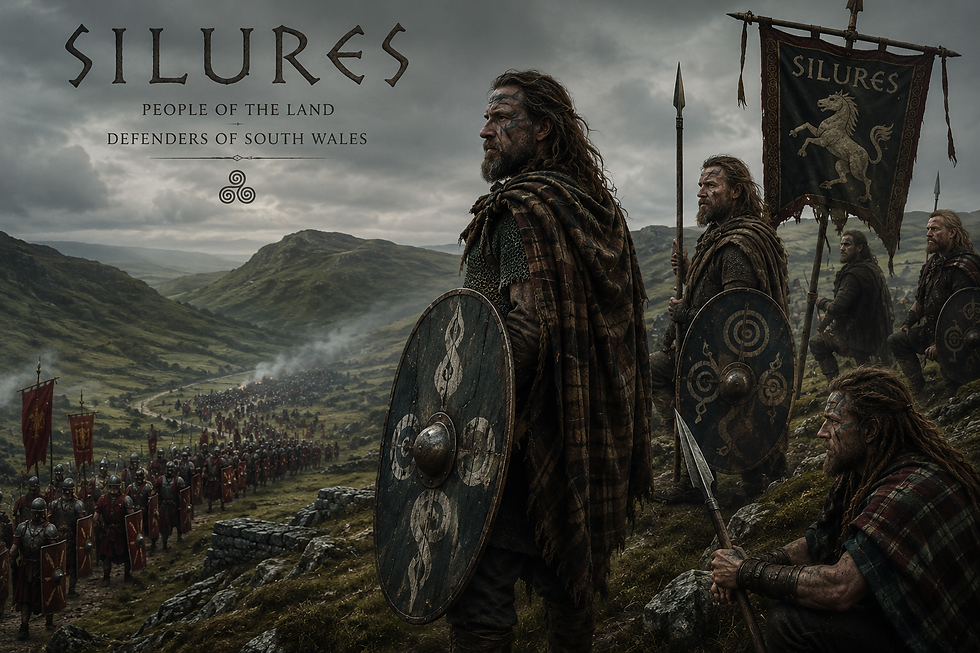
The Celtic warriors of ancient Britain were very real, forming the backbone of tribal societies long before and during the Roman invasions. Tribes such as the Silures were known for their fierce resistance, using knowledge of their land, speed, and guerrilla tactics to challenge even the disciplined Roman legions. Described by writers like Tacitus, these warriors were not just fighters but symbols of identity and pride—often adorned with body paint, carrying distinctive shields, and bound by loyalty to their people. Their existence is well documented through Roman accounts and archaeological finds, leaving behind a legacy of strength, resilience, and deep connection to the land.
The Silures – Defiance in the Hills of South Wales
The Silures of south Wales were not a people easily conquered. When the mighty Roman Empire pushed into Britain, expecting swift submission, they instead met a force rooted deeply in the land—fierce, intelligent, and unyielding. Described by the Roman historian Tacitus as stubborn and warlike, the Silures refused to bow, choosing resistance over surrender at every turn.
Under the shadow of invasion, they fought back with cunning and determination. Alongside leaders such as Caratacus, they launched ambushes, disrupted Roman advances, and inflicted repeated defeats on one of the most powerful armies the world had ever seen. This was not a single victory, nor a brief uprising—it was a sustained resistance that frustrated Rome for decades.
It took the Romans many years, countless resources, and relentless campaigns before they could finally claim control of Silurian lands. Even then, it was not a true victory of spirit. The legacy of the Silures lives on as a symbol of Welsh resilience—of a people who stood their ground, who knew their worth, and who would not be easily broken.

The Celtic world was not made up of one single people, but of many proud and independent tribes, each with their own warriors, lands, and traditions. In Britain alone, tribes such as the Silures, Ordovices, and Iceni stood firm against Roman expansion, while further north the Caledonians resisted from the rugged Highlands. Across the sea, the Gauls of mainland Europe fought their own battles, led by figures such as Vercingetorix. Though separated by distance, these warriors shared a common spirit—deeply connected to the land, fiercely independent, and unwilling to surrender their identity. Together, they form a powerful legacy of resilience that still echoes through Celtic history today.
Comments